.png)

Choosing Couples Counselling: A Guide for Australians

What if the recurring arguments that leave you feeling exhausted aren't actually a sign that your relationship is failing, but rather a signal that your nervous systems are stuck in a cycle of protection?
It's incredibly draining to feel like you're speaking a different language than the person you love most, especially when the emotional safety you once shared feels like a distant memory. Many Australians find themselves at this crossroads, wondering if the distance between them has become too wide to bridge. We understand that the search for the right couples counsellor or relationship therapist can feel overwhelming, particularly when you're already carrying the weight of a strained connection.
At The Project Of You, Azita Abdollahian, Clinical Social Worker, psychotherapist, trauma specialist and relationship expert, has helped hundreds of individuals and couples break destructive relationship patterns by addressing the underlying trauma, attachment wounds and nervous system responses that traditional communication strategies often miss. Rather than simply managing conflict, her approach focuses on creating lasting transformation by helping couples understand why they react the way they do and how to rebuild genuine emotional safety.
In this guide, we'll move beyond clinical jargon to show you how modern, trauma-informed couples counselling can help you reconnect with your partner and restore trust. You'll learn how to identify the right support for your unique situation, whether that involves weekly relationship therapy, intensive couples retreats or individual trauma work, all through a lens that prioritises nervous system regulation, emotional resilience and long-term healing.
Drawing on years of clinical experience supporting couples across Australia, Azita and The Project Of You combine evidence-based therapeutic approaches with deep insight into trauma, attachment and relationship dynamics. Our goal isn't simply to help couples communicate better—it's to help them create relationships where both partners feel seen, understood, emotionally safe and deeply connected.
Whether you're searching for couples counselling in Sydney, online relationship therapy, marriage counselling or expert guidance to strengthen your relationship, this guide will provide a clear path forward and practical strategies to rebuild connection, regulate stress and restore warmth, intimacy and security in your relationship.
Table of Contents
Beyond Just Talking: Why Your Nervous System Holds the Key to Relationship Harmony
Most of us imagine that couples counselling involves sitting on a couch and having a neutral third party help us decide who is right and who is wrong. While traditional mediation has its place, true healing often happens at a much deeper level than our words. It happens in the body. When you find yourselves stuck in those circular arguments that never seem to resolve, it's rarely because you lack the right vocabulary. It's usually because your nervous systems have perceived a threat and have moved into a state of protection rather than connection.
This is where the concept of Polyvagal Theory becomes a practical tool for your relationship. In simple terms, our brains are constantly scanning the environment for cues of safety or danger. When we feel "unsafe" with our partner, perhaps due to a sharp tone or a distant look, our biological system hijacks our ability to think logically. You can't solve a complex emotional problem when your body is preparing to fight, flee, or shut down. By focusing on Nervous System Restoration, we work to lower the baseline of stress in your partnership, shifting the focus from "who is right" to "how do we feel safe together?"
The Science of Connection and Co-regulation
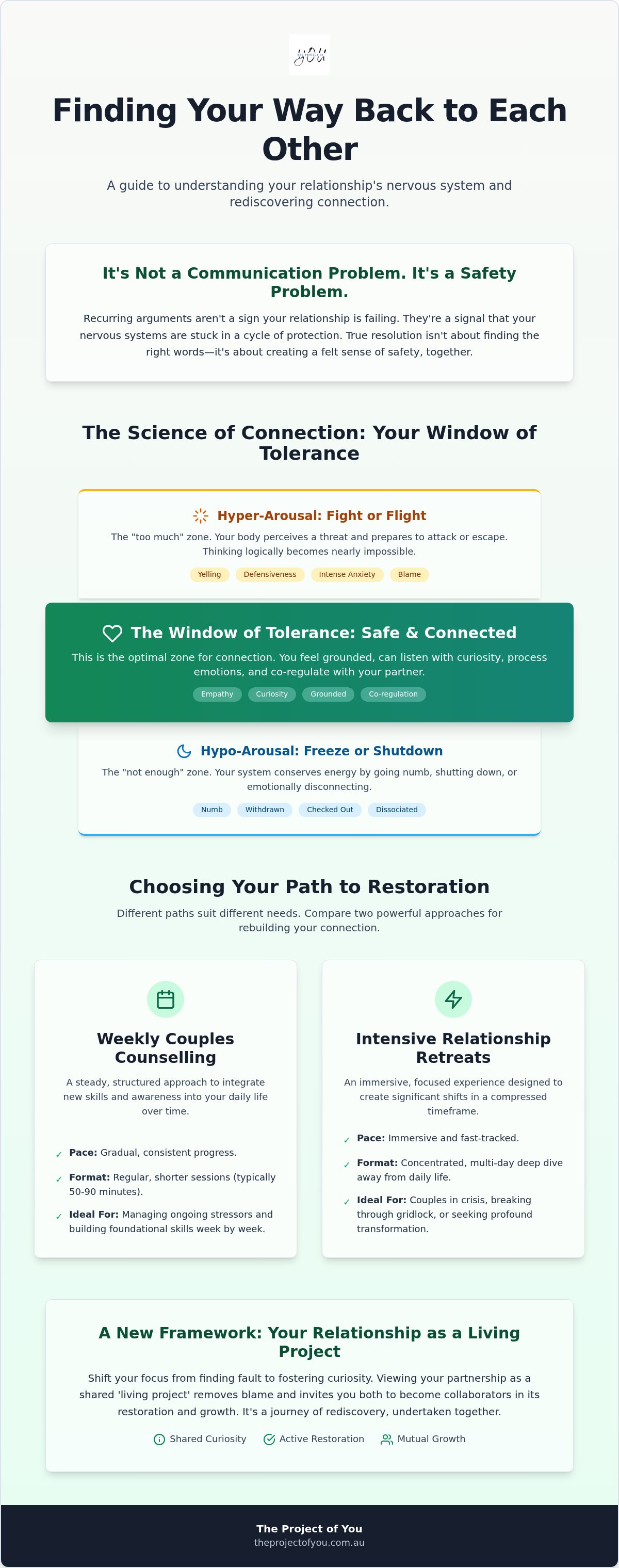
Have you ever noticed how your partner's stress seems to "rub off" on you? This isn't just your imagination; it's a biological reality. In a close relationship, our nervous systems are tethered together. When one person becomes highly agitated, the other often follows suit. This is why we talk about the "Window of Tolerance". This is the emotional space where you both feel grounded and able to process feelings without becoming overwhelmed or completely withdrawn.
Staying within the window: When you are both regulated, you can listen with curiosity and empathy.
Hyper-arousal: This is the "fight or flight" zone, characterised by yelling, defensiveness, or intense anxiety.
Hypo-arousal: This is the "freeze" zone, where one partner might go numb, shut down, or emotionally check out.
Co-regulation is the steady, shared heartbeat that allows two people to find their way back to calm through their connection with each other.
When Talk Therapy Isn’t Enough
Many couples come to Couple Counselling feeling "talked out". They've explained their problems a thousand times, yet the same patterns repeat. This often happens because the trauma or hurt is stored in the body's memory, not just in the mind's narrative. If your body still feels like it's in a war zone, no amount of "I" statements will create lasting peace.
By introducing somatic awareness, we begin to notice the physical sensations that precede a blow-up. Is there a tightness in your chest? A heat in your neck? Recognising these signals allows us to intervene before the argument spirals. This approach moves the relationship through transitions with grace, ensuring that both of you feel heard not just by the ears, but by the heart and the nervous system as well.
Understanding the Roots: How Attachment Styles and Trauma Shape Your Partnership
If you've ever wondered why certain moments with your partner trigger an intense emotional reaction, it's helpful to look at the blueprints you're following. Long before you entered your current relationship, you were already learning how to love and be loved. These early experiences create an internal map for how we relate to others. When you begin to explore what is counselling, you often start by unpicking these maps to see where they might be leading you astray. In the context of couples counselling, we look at these patterns not to find fault, but to foster a deep sense of curiosity about our shared history.
Trauma isn't always a single, catastrophic event. It can be the quiet, persistent absence of emotional safety in childhood or the cumulative stress of previous heartbreak. These experiences live in our bodies and influence how we approach intimacy today. When a partner pulls away or pushes for more closeness, it can inadvertently poke at an old wound, causing our nervous system to react as if we are in immediate danger. Recognising that your partner's reaction is often about their past, rather than your present, is a powerful step toward healing.
Attachment Styles in Everyday Life
Most Australian couples I see in my practice are caught in a familiar rhythm, often called the "anxious-avoidant dance". This happens when one partner craves high levels of intimacy and reassurance (anxious attachment), while the other values independence and may retreat when things feel too intense (avoidant attachment). Those with a secure attachment style generally feel comfortable with both closeness and autonomy. I invite you to pause and wonder: "When I feel overwhelmed in our relationship, what is my nervous system trying to protect?"
Understanding these styles reduces shame. You aren't "needy" or "cold"; you are simply operating from a survival strategy that once served you well. By identifying these blueprints, we can move toward a more secure way of relating, where both partners feel safe enough to be vulnerable without fear of rejection or engulfment.
Betrayal Trauma and Infidelity Recovery
When infidelity occurs, it's far more than a lapse in judgement. It is a profound rupture in the attachment bond that can feel like an emotional earthquake. For the partner who was betrayed, the world no longer feels safe, and their nervous system may remain in a state of high alert. This is a form of clinical trauma that requires specialised, tender care to navigate.
Recovery requires more than just an apology; it requires a structured process of rebuilding transparency and emotional safety. The Project of You’s infidelity recovery approach focuses on honours this pain while providing a clear path toward restoration. We work together to understand the "why" behind the rupture and create new, stronger boundaries for the future. If you're ready to start unpicking these patterns and find a way back to each other, you can book a session to begin this important work.
Comparing Your Options: Weekly Counselling vs. Intensive Couples Retreats
Deciding how to approach couples counselling is often a matter of timing, intensity, and the current "temperature" of your relationship. There isn't a one-size-fits-all model for healing. For some, a steady, weekly touchpoint provides the necessary structure to integrate small, sustainable changes into a busy Australian life. For others, particularly those in the midst of a significant crisis or feeling deeply disconnected, a more immersive experience is required to break through years of protective patterns. It's about looking at your relationship as a living project and asking what kind of environment will best support its restoration right now.
The choice between these formats usually comes down to your capacity for emotional intensity and the urgency of your situation. Weekly sessions offer a "slow and steady" rhythm that allows for long-term integration. Conversely, an intensive retreat provides a deep dive that can jumpstart a stalled healing process. Both paths require a commitment to curiosity, but they navigate the journey of repair at very different speeds.
The Case for Weekly Sessions
Weekly sessions are often ideal for couples who have a relatively stable foundation but find themselves tripping over the same communication hurdles. These hour-long appointments allow for gradual growth and the "fine-tuning" of relationship health. It's a bit like regular exercise for your partnership; it keeps the connection toned and resilient. However, it's important to manage what we often call the "therapeutic hangover." This is the period of emotional vulnerability that can follow a deep session. When you're juggling school runs, work deadlines, and household chores in the suburbs, finding the space to process these insights together can be a challenge. Weekly work is best suited for those who can commit to the long-term maintenance of their bond.
Why Intensive Retreats Create Rapid Change
When a relationship is in a state of high alert, weekly sessions can sometimes feel like trying to put out a bushfire with a garden hose. This is where a Private Couples Retreat offers a different path. By compacting several months of therapy into just a few days, we create an environment of focused healing that allows for rapid breakthroughs. You're removed from the daily triggers of your home environment. The unwashed dishes, the bills, and the familiar seating arrangements are replaced by a nurturing, neutral space.
This immersion helps your nervous system settle into a state of safety, making it far easier to access the vulnerability needed for true repair. Doing six months of work in three days might sound intense, and it is. Yet, for many couples, this "compaction" is exactly what's needed to move past a plateau of resentment or to begin the delicate process of rebuilding after a betrayal. It's a premium recovery option for those who are ready to prioritise their connection without the distractions of everyday life.
Finding a Trauma-Informed Relationship Therapist
Selecting a therapist is a deeply personal decision that requires more than just a quick search for local clinics. In Australia, the term "counsellor" is not as strictly regulated as "psychologist" or "clinical social worker", so it's vital to look closely at the specific credentials and training of your practitioner. When you are looking for couples counselling, you want someone who doesn't just listen, but actively leads the session with a structured, evidence-based approach. A trauma-informed therapist understands that "neutrality" doesn't mean being passive. Instead, it means holding a safe, firm space where both of you can be heard without the session spiralling into the same conflict you experience at home.
The best therapists for relationship work are those who understand the intricate connection between the mind and the body. They don't just focus on the story of what happened; they look at how that story is currently living in your nervous system. This holistic view ensures that therapy doesn't become a place where you simply repeat your grievances. Instead, it becomes a laboratory for new ways of relating. You should feel that your therapist is a compassionate guide who has the professional authority to stop a session if it becomes unsafe, ensuring that the process remains restorative rather than re-traumatising.
The Essential Checklist for Choosing a Practitioner
When you are researching potential therapists, it's helpful to have a clear set of criteria. Look for clinicians who have specific training in evidence-based models like the Gottman Method or Attachment Theory. These frameworks provide a roadmap for healing that is grounded in decades of research. It's also crucial to ask about their experience with your specific challenges. If your relationship is reeling from infidelity, you need an expert in affair recovery who understands the unique trauma of betrayal. A generalist approach may not provide the depth of care required for such a complex rupture.
Questions to Ask During Your First Chat
Most practitioners offer an initial consultation or a brief phone chat. This is your opportunity to interview them and see if their style aligns with your needs. You might ask how they handle high-conflict sessions or what their specific approach to nervous system regulation looks like. Their answers should be clear, grounded, and free of heavy clinical jargon. You want to hear how they ensure both partners feel heard and safe, especially when discussing sensitive topics. This conversation is less about their "correct" answers and more about how you feel while talking to them.
Finally, I encourage you to trust your gut feeling. Your nervous system is incredibly adept at sensing whether a person is safe and trustworthy. If you feel judged, unheard, or simply "off" during that first chat, it's okay to keep looking. The relationship you build with your therapist is the foundation upon which your relationship with your partner will be rebuilt. It needs to be a solid, supportive, and deeply empathetic connection.
Beginning Your Journey of Restoration with The Project of You
At the heart of everything we do is a simple belief: you are not a problem to be solved, and your relationship is not a failure to be managed. Instead, we view your partnership as a living, breathing project that requires intentional care and a solid foundation of emotional safety. As a clinical social worker and neurofeedback trainer, I’ve seen how transformative it can be when couples stop blaming each other and start looking at their shared nervous system responses with curiosity. This is the essence of couples counselling at The Project of You. It’s a space where evidence-informed science meets deep, intuitive empathy, providing you with a steady hand as you navigate the complexities of your journey together.
Choosing to seek help is an act of profound courage. It’s an acknowledgement that while the path forward may currently feel obscured by conflict or hurt, you are willing to pick up the tools needed to rebuild. Our philosophy is grounded in the idea that transformation is always possible when we prioritise human connection over clinical detachment. We don't just want to help you stop fighting; we want to help you rediscover the ease and warmth that comes with a truly supported partnership.
Our Unique Therapeutic Ecosystem
We’ve designed a holistic ecosystem of care that supports you at every stage of your restoration. While many centres offer standard talk therapy, we integrate cognitive behavioural therapy (CBT) with advanced somatic modalities like Nervous System Restoration and, where appropriate, Psychedelic Assisted Therapy. This multi-layered approach ensures that we are addressing the mind, the body, and the spirit of your connection.
For those who feel they need to do some individual work alongside their relationship repair, The Healing Feminine Workshops offer a powerful space for personal growth and reclaiming your sense of self. If you aren't quite ready for a formal session but want to start exploring these concepts at your own pace, our Self Love E-books provide a gentle entry point into the world of self-compassion and attachment healing. Every resource we offer is designed to help you move through transitions with greater grace and self-understanding.
Take the First Step Toward Connection
Taking the first step toward healing can feel heavy, yet it is also the moment where hope begins to take root. Whether you are looking for the immersive, fast-tracked experience of a private retreat or the consistent, grounding support of weekly sessions, we are here to walk beside you. You don't have to carry the weight of a fractured connection alone. By choosing to invest in your relationship, you are choosing a future where intimacy and trust are daily realities rather than distant memories.
We invite you to reach out and enquire about how our structured, intentional approach can help you find your way back to each other. Even when things feel incredibly difficult, there is a path forward, and it begins with a single conversation. We are ready to listen, to guide, and to support you as you begin this vital work of restoration.
[Book your initial consultation online to begin your restoration.
Finding Your Way Back Together
What if the distance you feel today is simply a map showing you where the repair needs to begin? We have explored how relationship harmony depends on more than just "better communication"; it requires a nervous system that feels safe enough to be vulnerable. By understanding your attachment blueprints and choosing a trauma-informed path, you can move from a state of protection to one of deep, authentic connection. Whether you are navigating the aftermath of betrayal or simply feel "talked out," the right support can help you organise your feelings and create a new, shared narrative.
Choosing couples counselling is an investment in the "Project of You," treating your partnership as a living work of restoration. Led by Azita Abdollahian, a Clinical Social Worker and Psychotherapist, our approach combines evidence-informed Gottman and Attachment techniques to provide a structured, compassionate way forward. Specialising in infidelity and betrayal trauma recovery, we focus on rebuilding the emotional safety that is essential for a lasting bond. There is a path from uncertainty to clarity, and you don't have to walk it alone.
Book your couples counselling session with Azita today](https://www.theprojectofyou.com.au/book-online)
Your relationship has the inherent potential for transformation. We look forward to holding a safe space for your growth and helping you rediscover the warmth and intimacy you deserve.
Frequently Asked Questions
How much does couples counselling typically cost in Australia?
In Australia, the cost for relationship support generally ranges from $150 to $350 per session, depending on the practitioner's qualifications and location. While this is a significant investment, many couples view it as a vital commitment to their long-term emotional health. Clinical specialists using advanced methods like the Gottman Method or somatic therapy may sit at the higher end of this scale due to their specialised training and the depth of the work provided.
Will our counsellor take sides or tell us if we should break up?
A professional therapist will never take sides or make the decision for you to separate. Our role is to act as a compassionate, neutral guide who helps you both understand the "dance" you are caught in. We focus on creating a space of psychological safety where you can gain the clarity needed to make your own informed decisions about the future of your partnership.
What if my partner is reluctant to attend counselling?
It's very common for one partner to feel hesitant, often fearing they will be blamed or judged. If this is the case, you might suggest attending just one session to see how the process feels. We focus on curiosity rather than criticism, ensuring that both individuals feel respected and heard as we explore how to lower the baseline of stress in the home.
How many sessions of relationship therapy will we need to see results?
The duration of the journey varies, but many couples begin to notice a shift in their dynamic within 8 to 12 sessions. While some may only require a few sessions for fine-tuning, others navigating complex issues like betrayal trauma or chronic conflict may need a longer period of restoration. We work at a pace that respects your unique nervous system and the specific goals you have for your connection.
Can we do couples counselling online, and is it as effective?
Online couples counselling is a highly effective and flexible option for busy Australians, with research indicating it can be just as impactful as face-to-face sessions. Many people find that being in their own familiar environment helps them feel more relaxed and open. As long as you have a private space and a stable connection, we can build a strong, restorative bond through telehealth.
What is the difference between marriage counselling and relationship coaching?
Marriage counselling is conducted by registered clinical professionals who are trained to address deep-seated trauma, mental health concerns, and complex attachment wounds. Relationship coaching is often more focused on future goals and practical skill-building. For couples dealing with significant emotional ruptures or the weight of the past, the clinical depth of a therapist is typically required for lasting change.
Is couples counselling covered by Medicare or private health insurance?
In Australia, couples counselling is not covered by Medicare, as the Better Access initiative only provides rebates for individual mental health care. However, some private health insurance "extras" policies do offer partial coverage for relationship therapy. We recommend checking directly with your health fund to see if your specific policy includes rebates for sessions with a clinical social worker or psychotherapist.
What happens if we decide to separate during the counselling process?
If you decide to separate, our work can transition into "conscious uncoupling" or pre-divorce counselling. This provides a structured, compassionate environment to navigate the end of the relationship with as much grace and respect as possible. This is especially helpful for couples who need to establish a healthy co-parenting foundation while processing the grief and transition of separation.


Comments