.png)

Healing from Infidelity: Rebuilding Trust and Safety
- Azita Abdollahian

- 3 days ago
- 13 min read
What if healing from infidelity isn't about finding the perfect apology, but about helping your nervous system feel safe again?
Infidelity is one of the most painful experiences a person or couple can face. Whether you've been betrayed or you're the partner trying to repair the damage, an affair doesn't simply break trust—it disrupts your sense of safety, security and connection. Many people experience betrayal trauma through intrusive thoughts, overwhelming anxiety, hypervigilance, emotional numbness or a constant replaying of events, making it difficult to know how to move forward.
At The Project Of You, Azita Abdollahian—psychotherapist, Clinical Social Worker, trauma specialist and relationship expert—has helped individuals and couples navigate the complex journey of healing after infidelity. Through a trauma-informed approach that integrates attachment theory, nervous system regulation and evidence-based relationship therapy, healing becomes more than simply "getting over it." It becomes an opportunity to understand what happened, repair emotional wounds and create healthier patterns moving forward.
If you're wondering how to heal from infidelity, whether a relationship can survive an affair, or how couples therapy can help rebuild trust after betrayal, the answer begins with creating emotional and physiological safety. Before meaningful conversations can take place, the brain and body need to move out of survival mode. By calming the nervous system first, it's possible to reduce emotional overwhelm, communicate more effectively and make thoughtful decisions about the future of your relationship.
In this guide, you'll learn a trauma-informed framework for recovering from infidelity, including practical strategies to regulate your nervous system, communicate without causing further harm, understand betrayal through the lens of Polyvagal Theory and Attachment Theory, and begin rebuilding trust—whether your goal is relationship recovery or personal healing. With the right support, even the deepest relationship wounds can become the starting point for profound growth, clarity and transformation.
Table of Contents
Understanding the 'Betrayal Trauma' Response in Your Nervous System
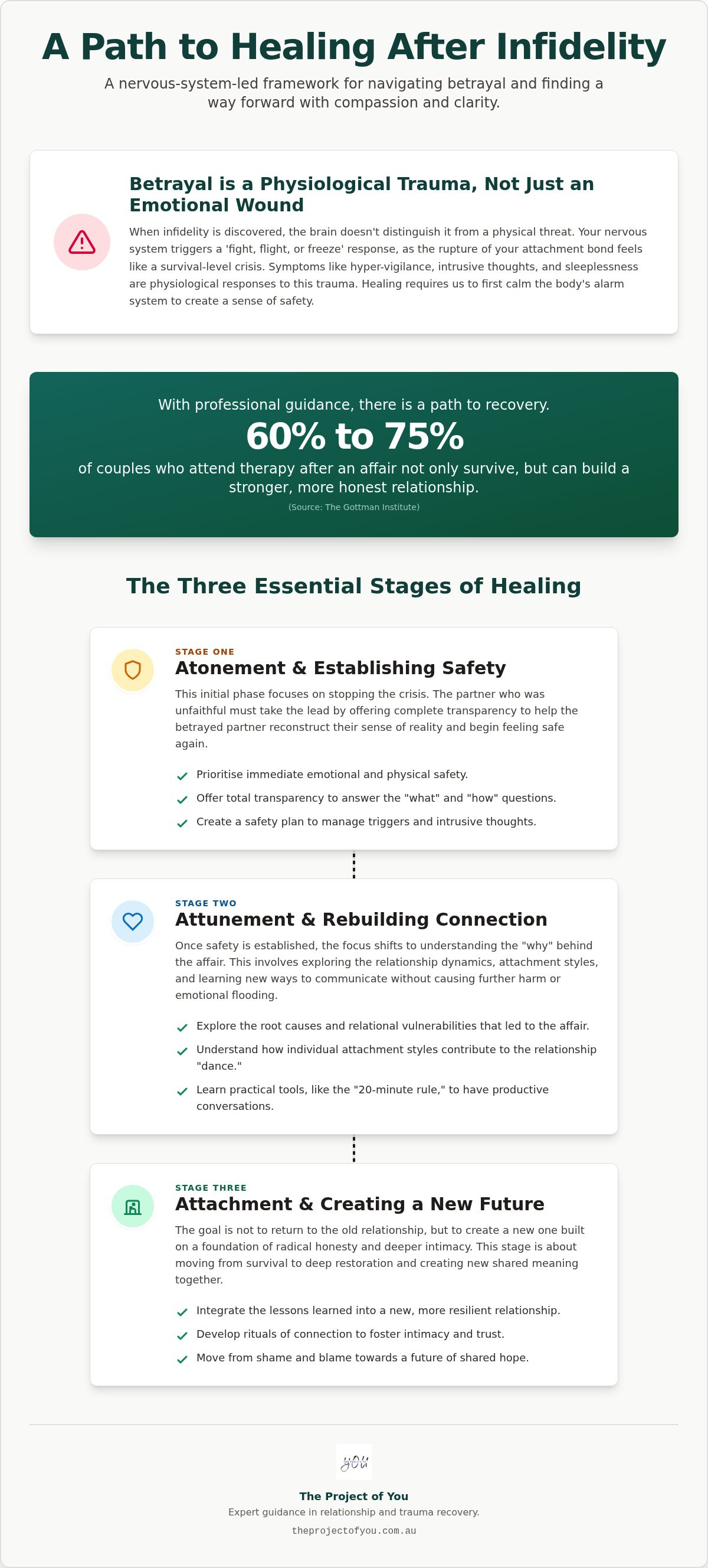
When you discover an affair, it feels like the world has suddenly tilted on its axis. This isn't just an emotional hurdle; it's what we call "betrayal trauma." In clinical terms, it's a profound rupture in the attachment bond you share with your partner. For most of us, our primary relationship is our "safe harbour." When that harbour is breached, the nervous system reacts as if your very survival is at stake. Instead of seeing a partner, your brain sees a threat.
This shift triggers the primitive "fight, flight, or freeze" response. You might find yourself lashing out in anger, wanting to pack a bag and run, or feeling completely numb and disconnected. Validating these reactions is a crucial part of learning how to heal from infidelity. You aren't "crazy" or "overreacting." You are experiencing an attachment injury that often mirrors the symptoms of PTSD, including hyper-vigilance, sleeplessness, and intrusive thoughts that play like a loop in your mind.
Why Infidelity Feels Like a Physical Injury
Your brain doesn't distinguish between a broken heart and a broken bone. The amygdala, which acts as your body's alarm system, goes into overdrive when betrayal is uncovered. It scans every text message, every late arrival, and every change in tone for signs of further danger. This "shock" is stored deep within your nervous system, often manifesting as physical pain, digestive issues, or a racing heart. Trying to "just get over it" is physiologically impossible because your body is still convinced it's under attack. True healing requires us to move past the idea of a "moral failure" and instead look at the physiological impact of the wound with compassionate curiosity.
Recognising the Signs of a Dysregulated System
A common experience in the aftermath of an affair is "flooding." This occurs when your heart rate spikes and your nervous system becomes so overwhelmed that the logical, thinking part of your brain effectively shuts down. When you're flooded, you can't process new information or have a productive conversation. It's the difference between the acute crisis pain of the first few weeks and the long-term processing required for deep restoration. Understanding this distinction is vital for anyone seeking Couple Counselling to navigate this crisis.
To find your way back, we must prioritise Nervous System Regulation: the intentional practice of bringing your body back into a state of "rest and digest" so that you can feel safe enough to engage in the work of repair. Discovering how to heal from infidelity involves recognising when your system is offline and learning the somatic tools to bring it back to centre. By reframing the affair as an attachment injury, we can begin to ask why the "dance" of your relationship changed, creating a map for the journey ahead without getting lost in the fog of blame.
The Three Essential Stages of Healing After an Affair
What if you could view this crisis not as the end of your story, but as the painful beginning of a more honest chapter? While it might feel impossible right now, research from the Gottman Institute suggests that 60 to 75 per cent of marriages that undergo therapy after infidelity actually survive. This isn't because they "got over it" quickly. It's because they followed a structured path to repair. Understanding how to heal from infidelity involves recognising that this is a non-linear journey. There is no quick fix, and the goal isn't to return to the old relationship that existed before the rupture. Instead, the focus is on creating a new, more resilient foundation built on radical honesty and emotional safety.
This process requires both partners to be fully present in the work. It’s a collaborative effort to move from the wreckage of betrayal toward a sense of shared meaning. We typically navigate this through three essential stages: Atonement, Attunement, and Attachment.
Stage 1: Atonement and Establishing Safety
In this initial phase, the priority is stopping the bleeding. The partner who was unfaithful must take lead by offering total transparency. This means answering the "how" and "what" questions to help the betrayed partner reconstruct their sense of reality. We often work together to create a safety plan, which might include shared calendars or check-ins to help manage intrusive thoughts. It’s usually best to let the deeper "why" questions wait until the nervous system feels more regulated. Safety must come before insight.
Stage 2: Attunement and Processing the Rupture
Once the initial crisis has calmed, we move into Attunement. This is where you learn to listen to each other's pain without falling into the trap of defensiveness. It’s about developing a shared narrative of what happened to the relationship, not just the affair itself. Many couples find that couple counselling provides the necessary container to have these high-stakes conversations safely. Learning how to heal from infidelity at this stage involves curious inquiry into the "dance" of your relationship and identifying where the music stopped playing long ago.
Stage 3: Attachment and Rebuilding the Future
The final stage is about looking forward. Forgiveness here isn't a grand, one-time event; it's a quiet, daily choice to stay engaged. You'll work on re-establishing intimacy and creating new rituals of connection that reflect who you are now. This is where you move from merely surviving the betrayal to truly thriving as a couple. If you feel ready to start navigating these stages with professional guidance, you might like to book a session to begin your journey.
Practical Strategies for Re-establishing Safety and Communication
While understanding the stages of recovery is helpful, the daily reality of learning how to heal from infidelity often feels like navigating a minefield. One moment you're having a calm breakfast, and the next, a song on the radio or a specific street corner sends your nervous system into a tailspin. These triggers are your body's way of trying to protect you from being blindsided again. To manage this, we use immediate grounding techniques. If you feel your heart racing, try the "5-4-3-2-1" method: name five things you can see, four you can touch, three you can hear, two you can smell, and one you can taste. This simple somatic tool helps pull your brain out of a "mind movie" and back into the present moment.
To prevent these triggers from consuming your entire day, I often recommend the "20-minute rule." This involves setting a specific, timed window to discuss the affair or your feelings of betrayal. When the timer goes off, the conversation stops. This containment prevents emotional flooding and ensures that your relationship isn't entirely defined by the trauma. It also allows you to establish boundaries around technology. Given that 38 per cent of affairs now begin online, according to 2026 research, total transparency with passwords and devices is often a non-negotiable first step in rebuilding a sense of safety.
Communicating Without Further Traumatisation
When you do speak about the rupture, the goal is to express pain without causing fresh injury. We use what the Gottman Institute calls a "Softened Start-up." Instead of saying, "You always lie to me," which triggers an immediate defensive response, try starting with your own experience: "I'm feeling anxious because I haven't heard from you, and I need some reassurance." Using "I" statements keeps the focus on your needs rather than your partner's flaws. If you notice one of you becoming overwhelmed, it's vital to "pause" the conversation. A 20-minute break allows your heart rate to drop so you can return to the discussion with a regulated system.
Restoring Individual Self-Worth
In the wake of betrayal, it's easy to let your partner's choices define your value. However, how to heal from infidelity also involves a deeply personal journey of self-compassion. You must consciously separate your worth from the actions of another person. Prioritising your own self-care, whether through exercise, hobbies, or spending time with supportive friends, helps rebuild the "you" that exists outside of this relationship crisis. Embracing Self Love is a radical act of recovery that reminds you that your inherent value remains untouched by another person’s choices. This individual restoration provides the internal stability needed to make long-term decisions about your future with a clear head.
Addressing the Root: Attachment Styles and Relationship Dynamics
Once the initial shock of discovery has been managed, the question of "why" inevitably surfaces. To understand how to heal from infidelity on a deeper level, we must look at the invisible blueprints that govern our relationships: our attachment styles. These styles, often formed in early childhood, dictate how we respond to intimacy, conflict, and the need for connection. When a relationship is under stress, these blueprints can lead to a "dance" between a "pursuer" and a "withdrawer," creating a cycle of disconnection that often precedes a rupture.
It’s important to be clear: understanding these dynamics does not excuse the betrayal. The choice to be unfaithful is always the responsibility of the person who made it. However, identifying the underlying attachment injury allows us to repair the foundational bond rather than just patching the surface. Attachment-based therapy provides the tools to see these patterns clearly, fostering curiosity instead of blame. It helps you understand the "why" so you can ensure it never happens again.
Breaking the Cycle of Avoidance and Pursuit
In many relationships, one partner may naturally lean toward avoidance while the other leans toward anxious pursuit. When the pressure of life or conflict becomes too much, an avoidant partner might use an affair as an "exit" or a distraction to create distance when the primary relationship feels too "suffocating." Conversely, for an anxious partner, the discovery of cheating triggers a profound trauma of abandonment. Learning how to heal from infidelity involves breaking this cycle by creating a "secure base" within the relationship. This is achieved through consistent, predictable actions that prove the relationship is once again a safe place to land for both of you.
The Role of Nervous System Regulation in Long-Term Repair
Long-term recovery isn't just about what you say; it's about how your bodies feel when you're together. A "regulated" couple can handle a disagreement without spiralling into a shouting match or a heavy, cold silence. By using somatic tools like shared breathing or grounding exercises, you can stay connected even during moments of high stress. This physiological safety is the bedrock of any lasting repair. For those who feel stuck in a cycle of high-alert or total shutdown, exploring a Nervous System Retreat can provide the intensive space needed to reset these patterns and find a new way of moving through life together.
Moving Beyond Survival: Deep Restoration and Professional Support
Sometimes, the standard hour-long session once a week feels like trying to empty the ocean with a teaspoon. When betrayal trauma is deep, your nervous system can remain in a state of high alert that "talk therapy" alone struggles to reach. If you are exploring how to heal from infidelity, it's worth considering whether an intensive approach might better serve your recovery. For some, Psychedelic Assisted Therapy offers a unique way to bypass the cognitive "survival brain" and address the deep-seated trauma that traditional methods sometimes miss. Choosing the right path means honouring the depth of your wound and the unique needs of your partnership.
The Power of Immersion: Why Retreats Work
Daily life is often full of reminders of the affair. Every time you walk past the spare room or see a specific notification on a phone screen, your system resets to a state of panic. A Private Couples Retreat allows you to step away from these environmental triggers. By removing the distractions of work, laundry, and social obligations, you create a dedicated container for repair. This immersion accelerates the healing process, giving your nervous system the space and safety required to finally "power down" and begin the work of deep restoration. It's about moving from a place of constant crisis into a nurtured environment where growth can finally take root.
Finding the Right Compassionate Guide
Choosing a professional to guide you through this transition is a significant step. You need more than just a listener; you need a trauma-informed specialist who understands attachment styles and the delicate art of nervous system regulation. Look for a guide who prioritises curiosity over blame and who can hold a safe, non-judgmental space for both of you. Azita Abdollahian and the team at The Project of You specialise in this exact work, combining clinical social work expertise with a deep, intuitive empathy for the human condition.
Remember, discovering how to heal from infidelity is a marathon, not a sprint. While the path may feel steep right now, you don't have to walk it alone. There is a way through the fog. With the right tools and a steady, professional presence beside you, it is possible to move beyond survival and create a relationship that is more conscious, connected, and resilient than ever before. Healing is a journey of a thousand small, regulated steps, and you are worthy of every one of them.
Finding Your Way Back to Centre
The journey toward restoration after betrayal is rarely a straight line. It's a series of intentional, regulated steps that move you from the chaos of a shattered reality toward a new sense of shared safety. By understanding the physiological impact of betrayal trauma and addressing the underlying attachment dynamics, you've already begun the vital work of repair. Learning how to heal from infidelity isn't just about the conversations you have; it's about the safety you build within your own body and your partnership.
Led by Azita Abdollahian, a Clinical Social Worker and Psychotherapist, The Project of You offers a specialised, trauma-informed approach designed to foster psychological safety. Whether you choose the path of individual counselling or find the immersive environment of a retreat more supportive, the goal remains the same: returning your nervous system to a state of ease so that genuine connection can flourish once more.
You don't have to navigate this transition alone. Hope is not a distant promise, but a path we can create together, one breath at a time. Your story isn't over; it's simply moving into a more conscious, resilient chapter.
Frequently Asked Questions
How long does it typically take to heal from infidelity?
Healing from betrayal is a long-term process that typically takes eighteen months to three years for most couples to navigate fully. This timeline isn't a fixed rule, but a reflection of the deep physiological repair required for the nervous system to feel safe again. It’s a marathon of small, consistent actions rather than a sprint. While the initial crisis may subside in months, rebuilding the foundation of trust requires sustained effort and patience from both partners.
Can a relationship truly be better after an affair?
It is possible for a relationship to become more honest and resilient after the rupture of an affair. Many couples describe their post-recovery bond as "Marriage 2.0," which is built on a more transparent and conscious foundation than the original relationship. By learning how to heal from infidelity through deep attunement, you can address long-standing issues and create a new, more profound level of intimacy that didn't exist before the crisis occurred.
Should I tell the children about the infidelity?
Most experts recommend keeping the specific details of infidelity between the adults involved to protect the children’s sense of security. Children need to feel that their home is a safe base, and adult relationship issues can often feel too heavy for them to carry. If they've already discovered the affair, provide age-appropriate honesty without sharing graphic details. Focus on reassuring them that both parents love them and that the adults are working to fix the situation.
What is the first thing we should do after an affair is discovered?
The first priority is to establish a sense of immediate safety and halt any further deception. This means the unfaithful partner must offer total transparency and cut all contact with the third party immediately. It’s also vital to avoid making permanent decisions about the future of the relationship while your nervous system is in a state of acute shock. Focus on basic self-care, like sleeping and eating, before attempting to process the deeper "why" of the betrayal.
How do I deal with the 'mind movies' and intrusive thoughts?
Intrusive "mind movies" are a hallmark of betrayal trauma and should be treated as a physiological symptom of a wounded nervous system. When these images arise, use somatic grounding tools, such as focusing on the sensation of your feet on the floor, to bring your brain back to the present. Recognising that these thoughts are your brain's attempt to protect you from future harm can help you meet them with self-compassion rather than panic or shame.
Is it normal to feel like I'm going 'crazy' after discovering cheating?
Feeling as though you’re losing your grip on reality is a completely normal response to the profound disorientation of betrayal. When your shared sense of truth is shattered, your brain struggles to organise the new information, leading to a state of hyper-vigilance or total shutdown. This isn't a sign of mental illness; it's a natural reaction to an attachment injury. Grounding yourself in a trauma-informed framework is a key step in learning how to heal from infidelity.
When is it time to walk away from the relationship?
Deciding to leave is a deeply personal choice that often becomes clearer once the initial physiological "fog" has lifted. It may be time to consider walking away if the unfaithful partner shows a persistent lack of remorse, continues to lie, or refuses to engage in the work of repair. If the relationship remains a source of ongoing traumatisation rather than a path toward restoration, prioritising your own individual safety and mental health becomes the most compassionate choice.
How can we rebuild sexual intimacy after betrayal?
Re-establishing sexual intimacy requires a foundation of emotional safety and should never be rushed or forced. Start with non-sexual physical touch, such as holding hands or hugging, to help your nervous system feel safe with your partner again. Open communication about triggers and boundaries is essential. By treating intimacy as a slow, collaborative journey of rediscovery, you can eventually move toward a place where physical connection feels like a restorative part of your shared future.


Comments