.png)

Healing the Wounded Feminine: Why High-Achieving Women Feel Exhausted and Disconnected

What if the relentless exhaustion you feel isn’t a sign that you need to work harder, but a signal that your nervous system has simply run out of capacity?
You can be successful, capable and seemingly have everything together, yet still feel disconnected from yourself. You may wake up exhausted, live in a constant state of pressure, struggle to slow down, or feel as though you are moving through life without ever truly being present in it. When stress becomes chronic, your body can remain locked in patterns of survival long after the immediate threat has passed.
As a psychotherapist, trauma expert and founder of The Project Of You, Azita Abdollahian takes a trauma-informed approach to helping women understand the connection between emotional wellbeing, the nervous system, attachment and the body. Her work recognises that meaningful healing involves more than simply thinking differently—it also requires creating a greater sense of safety within the body.
This is the foundation of a trauma-informed healing feminine workshop: creating a professionally guided space where women can step out of their usual roles, reconnect with themselves and develop practical tools for nervous system regulation and emotional wellbeing.
In this guide, Azita explores how somatic practices, nervous system regulation and attachment awareness can help you understand why you feel stuck in survival mode—and what you can begin doing to move toward greater calm, connection and inner stability.
Healing isn't about becoming a different version of yourself. It's about creating enough safety to finally reconnect with the woman who has been there all along.
Table of Contents
Understanding the Need for a Healing Feminine Workshop
A healing feminine workshop is far more than a simple retreat or a weekend of relaxation. It's a dedicated somatic space designed for deep emotional and physiological restoration. While many spaces focus on intellectual self-help, this process prioritises the body's wisdom, creating a sanctuary where you can move beyond the "doing" of daily life and into a state of "being." At The Project of You, we see this as an essential path for women who have spent years prioritising everyone else's needs at the expense of their own internal harmony.
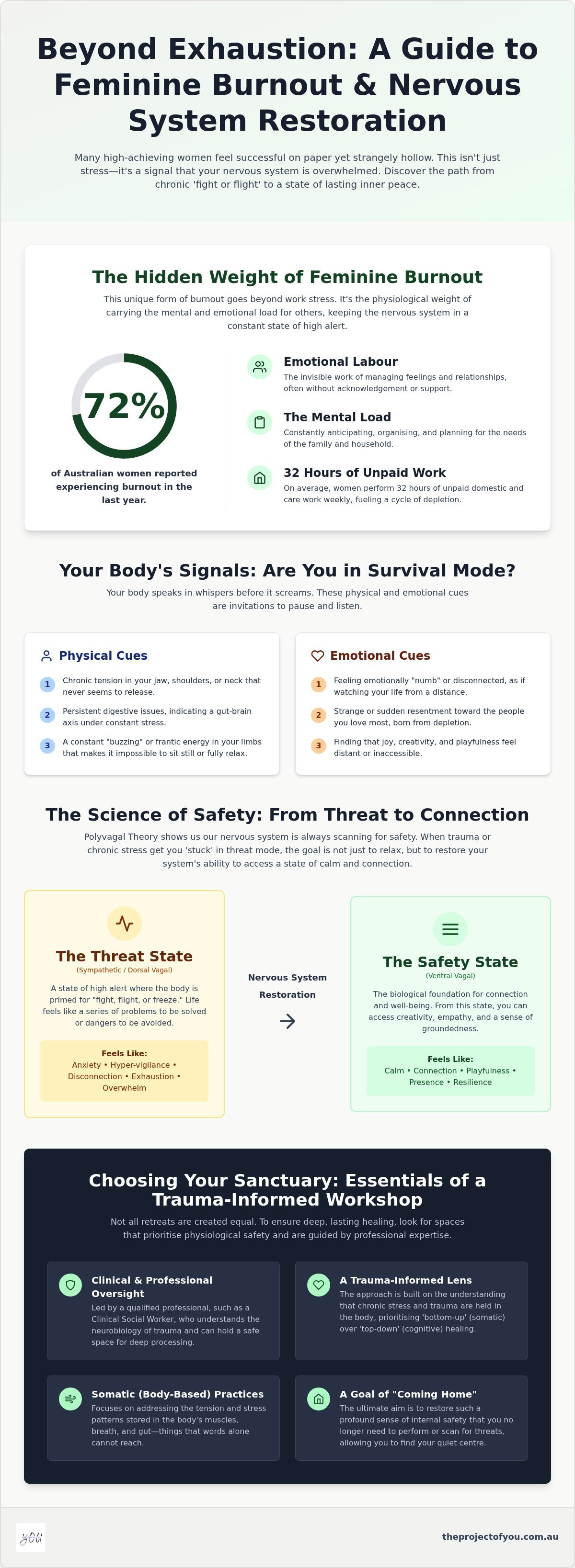
Many high-achieving women are currently navigating what we call "Feminine Burnout." This isn't just standard work stress; it's the unique physiological weight of carrying the mental load of caregiving and relationship labour. Recent data reveals that 72% of women have experienced burnout in the last year, often compounded by the fact that women perform an average of 32 hours of unpaid domestic work weekly. This constant output keeps the nervous system in a state of high alert, making it difficult to ever truly feel at rest.
You might have found that talk therapy, while helpful for gaining insight, sometimes misses the "body's story." Trauma and chronic stress aren't just stored in our memories; they're held in our muscles, our breath, and our gut. By focusing on somatic recovery, we can address the tension that words alone cannot reach. This approach draws on the evolution of Feminine psychology, which acknowledges that a woman's psychological health is deeply intertwined with her social roles and her sense of physiological safety.
Ultimately, this work is about "coming home to yourself." It's the process of establishing a sense of psychological safety so profound that you no longer feel the need to constantly scan for threats or perform for approval. It's about finding that steady, quiet centre that exists beneath the noise of your professional and personal obligations.
Why Traditional Stress Management Often Fails Women
Most corporate wellness programmes focus on "managing" stress through better time management or occasional exercise. However, there's a vital difference between managing a symptom and restoring the nervous system to its baseline. Societal expectations often force women into a perpetual "doing" mode, where worth is tied to productivity. This suppresses the "being" state, leading to high-functioning anxiety where you appear calm and capable on the outside while feeling a frantic, underlying current of dread on the inside. True restoration requires us to step out of this cycle entirely.
Identifying the Signs You Need a Somatic Reset
Your body often speaks in whispers before it screams. You might notice physical cues like chronic tension in your jaw or shoulders, persistent digestive issues, or a constant "buzzing" sensation in your limbs that makes it impossible to sit still. Emotionally, you may feel "numb" or strangely resentful toward the people you love most, finding that joy feels distant or inaccessible. A somatic reset is the transition from survival mode to a state of social engagement.
The Science of Safety: Nervous System Restoration and the Feminine
To understand why a healing feminine workshop is so effective, we must first look at the biology of safety. Polyvagal Theory, a cornerstone of our work at The Project of You, explains that our nervous system is constantly scanning our environment for cues of danger or safety. When we speak about "feminine energy," we are often describing the Ventral Vagal state. This is the physiological foundation of connection, playfulness, and calm. For many high-achieving women, this state has become inaccessible, buried under layers of chronic stress and the "always-on" nature of modern life.
When you have experienced betrayal trauma or have deep-seated attachment wounds, your nervous system can become stuck in a loop of hyper-vigilance. You aren't just "stressed"; your body has physically forgotten how to feel safe. This is where Nervous System Restoration becomes vital. Unlike simple relaxation, restoration involves a structured, trauma-informed approach to rewiring these responses. Having a facilitator who is a qualified Clinical Social Worker ensures that this process is handled with the professional oversight and neurobiological understanding necessary for true healing.
Polyvagal Theory in Plain English
Think of your nervous system as a ladder with three primary rungs. At the top is the Safe and Social state (Ventral Vagal), where you feel connected and creative. The middle rung is the Mobilised state (Sympathetic), which triggers "fight or flight" responses like anxiety or anger. The bottom rung is the Immobilised state (Dorsal Vagal), where you feel numb, dissociated, or "shut down." Our workshops create a "container" of safety, using somatic tools to gently help you climb back up that ladder, moving out of shutdown and back into a state of secure attachment and self-regulation.
Moving Beyond 'Self-Care' into True Restoration
While bubble baths and scented candles are pleasant, they aren't enough to repair a dysregulated nervous system. True restoration requires co-regulation, which is the biological process of our nervous systems calming down in the presence of another safe, grounded person. Being in a group of women who are all committed to this trauma-informed work provides a powerful healing resonance that you simply cannot achieve alone. It's a profound shift from individual "coping" to collective "healing." If you feel ready to transition from survival mode into a state of genuine ease, you might like to check our upcoming workshop availability to see if a somatic reset is the right next step for you.
What to Look for in a Transformative Women’s Workshop
Selecting the right environment for your growth is a vital act of self-stewardship. In Australia, the landscape of women's retreats is vast, ranging from purely spiritual gatherings to clinical intensives. While "wild woman" circles have their place, high-achieving women navigating burnout or betrayal trauma often require more than just ritual. They need a clinical foundation. Choosing a healing feminine workshop led by a qualified Clinical Social Worker or Psychotherapist ensures that your experience is grounded in psychological safety and professional ethics.
Professional credentials matter because social work is a self-regulated profession in this country. When you work with a practitioner who holds Accredited Clinical Social Worker status, you're engaging with someone who has met rigorous standards of post-qualifying experience. This expertise allows them to blend soulful connection with evidence-based frameworks like CBT, the Gottman Method, or Attachment-informed care. Before you commit to a healing feminine workshop, ask if there is a preliminary intake process or a chat. A professional facilitator will always prioritise whether the space is a safe fit for your current nervous system state.
5 Pillars of a Safe Healing Space
A truly transformative space is built on foundations that honour your agency and your history. You shouldn't feel like a passive observer in your own healing. Look for these core elements:
Confidentiality and clear boundaries: This is the non-negotiable bedrock of trust in any group setting.
Choice and agency: You should always feel in control of your participation; a trauma-informed space never "pushes" you to share more than you're ready for.
Professional oversight: The presence of a clinician who can identify and manage signs of emotional overwhelm in real-time.
Intake screening: A structured way to ensure the workshop meets your specific needs and that you're at a stage where group work is appropriate.
Integration support: A plan for how you'll carry your discoveries back into your daily life once the experience ends.
The Role of Somatic Practices
Not all movement is created equal. Some practices aim for "catharsis," which can involve intense emotional release that sometimes leaves the nervous system feeling raw or even re-traumatised. Instead, look for somatic work that focuses on "gentle expansion" and restoration. This is how The Project of You structures its immersive experiences. We prioritise movement that helps you find your way back to a state of calm, ensuring that you leave feeling nourished rather than depleted. It’s about creating a path toward long-term resilience, not just a temporary emotional peak.
Preparing for Your Journey: What to Expect
Deciding to attend a healing feminine workshop is a significant step toward reclaiming your vitality. It is natural to feel a mix of anticipation and perhaps a little trepidation as the date approaches. This preparation isn't just about packing a bag; it's about gently beginning the process of turning your attention inward. Before you arrive, I encourage you to spend a few moments each day simply checking in with your nervous system. Notice where you might be holding tension and allow yourself to set a soft intention for what you hope to find, whether that is a sense of calm, a deeper connection to your body, or simply a moment of stillness.
During the workshop, we follow a deliberate flow designed to honour your physiological needs. We begin with grounding practices to establish a collective sense of safety, ensuring everyone feels held and secure. From this steady base, we move into exploration, using somatic tools to gently uncover the stories your body has been carrying. We then transition into integration, allowing the day's discoveries to settle. To ensure your physical comfort, I recommend bringing comfortable layers to suit the changeable Australian weather, a water bottle, and a journal to capture any reflections that arise during our time together.
The Emotional Arc of a Healing Workshop
It's quite common to feel a surge of "nerves" before you walk through the door. Rather than seeing this as a reason to pull back, try to view it as a sign that your system is paying attention and preparing for change. The journey of the day often involves a beautiful transition from the "head," where we analyse and overthink, to the "heart," where we can truly feel and connect. The integration phase acts as the essential bridge between the profound insights of the workshop and the practical rhythm of your daily life.
Integrating the Experience at Home
The work doesn't end when you leave the workshop; in many ways, it's just beginning. To maintain the growth you've experienced, you might find it helpful to explore our Self Love E-books, which offer structured reflections to support your ongoing journey. Simple daily rituals, such as five minutes of mindful breathing or a short walk in nature, can help keep your nervous system in a restored state. If you find that the workshop has surfaced deeper themes that require more focused attention, seeking individual counselling can be a wonderful way to deepen your insights and continue your path toward healing.
Reclaiming Your Essence with The Project of You
At The Project of You, we believe that reclaiming your essence is not about adding more to your to-do list; it is about stripping away the layers of performance that have left you feeling hollow. Our healing feminine workshop is designed as a sanctuary where your professional achievements take a back seat to your physiological needs. By integrating clinical social work expertise with soulful somatic practices, we create a space where you are truly seen, heard, and supported. It is a rare opportunity to step out of the "doing" mode and into a state of deep, intentional presence.
The core of our approach is "Restoration." While many programmes focus on managing symptoms or providing temporary regulation, we aim for something deeper. Restoration is about giving your nervous system the profound rest it has been craving for years. It is the process of repairing the internal wear and tear caused by chronic "fight or flight" states, allowing your body to finally feel that it is safe to let go. This isn't just a weekend away; it's an investment in your long-term resilience and your ability to connect with yourself and others from a place of abundance rather than depletion.
A Space Held by Clinical Expertise
What sets this healing feminine workshop apart is the grounded, professional confidence that comes from over 20 years of clinical experience. Azita Abdollahian, our founder and a qualified Clinical Social Worker, brings a wealth of knowledge in trauma recovery and relationship healing to every session. This neuro-informed approach ensures that every somatic exercise and group interaction is handled with the highest level of psychological safety. You can read more about Azita's journey and her philosophy of combining evidence-based therapy with intuitive, human connection.
Your Invitation to Restore
If you've felt a persistent "inner nudge" telling you that there must be a more peaceful way to live, I invite you to listen to that voice. You don't need to be "broken" or in the midst of a crisis to attend our workshops; you simply need to be human and ready for a change. Whether you are navigating the aftermath of betrayal, struggling with burnout, or simply feeling a sense of disconnection, this space is for you. It is a gentle invitation to put down the heavy weights you've been carrying and find your way back to your steady, soulful centre.
Your Path Back to Soulful Connection
Reclaiming your vitality isn't about working harder; it's about learning to listen to your body's quietest needs. We've explored how a trauma-informed healing feminine workshop provides the somatic tools needed to move out of chronic stress and into a state of genuine restoration. This journey requires moving beyond talk therapy to address the body's story directly, using Polyvagal Theory to create a lasting sense of safety. By choosing a space held by clinical expertise, you ensure that your growth is both emotionally deep and psychologically safe.
You deserve a life that feels as good on the inside as it looks on the outside. Azita Abdollahian, a qualified Clinical Social Worker and Psychotherapist, is here to guide you through this transformative experience with compassion and grounded authority. It's time to put down the heavy weights of performance and find your way back to your steady, soulful centre. Your restoration is waiting.
Take that first gentle step toward the ease and connection you've been longing for. We look forward to holding a space where you can finally be truly seen and supported.
Frequently Asked Questions
What exactly is a healing feminine workshop?
A healing feminine workshop is a structured, somatic space focused on emotional and physiological restoration rather than just intellectual understanding. It's designed to help you move out of chronic "fight or flight" and into a state of regulated connection. Unlike a typical seminar, this experience prioritises the body's wisdom, using neuro-informed tools to address the tension and disconnection that high-achieving women often carry in their daily lives.
Do I need to have experienced trauma to attend a women's workshop?
You don't need a history of acute trauma to benefit from this experience. While our approach is trauma-informed, the workshop is equally valuable for women experiencing burnout or general life exhaustion. Whether you're navigating relationship stress or the weight of unpaid domestic work, this space offers a reset. It's about restoring your nervous system to a state of baseline safety, regardless of your specific clinical history.
Will I be expected to share my personal story with the whole group?
Sharing your personal story is entirely optional and never forced. We prioritise your agency and psychological safety, meaning you have full control over what you choose to disclose. You shouldn't feel pressured to speak; many of the somatic exercises are internal and don't require you to speak to the group at all. The goal is your own internal restoration, and we respect the boundaries that allow you to feel secure.
How is this different from a standard yoga or meditation retreat?
This experience differs from a standard retreat because it's led by a Clinical Social Worker and grounded in neurobiology. While yoga or meditation are wonderful tools, this healing feminine workshop integrates evidence-based frameworks like Polyvagal Theory and Attachment-informed care. We focus on the restoration of the nervous system rather than just temporary relaxation, providing you with practical, clinically-backed strategies that you can carry back into your professional and personal life.
Is a feminine workshop suitable for someone with a clinical diagnosis like PTSD?
Yes, a clinically-led workshop can be very supportive for those with PTSD, provided you're currently in a stable place. Because the space is held by a trauma specialist, the exercises are designed to avoid re-traumatisation. We use a preliminary intake process to ensure that group work is the most helpful step for your current healing journey, always prioritising your long-term stability and emotional safety above all else.
What should I look for in a workshop facilitator's background?
You should prioritise facilitators with formal clinical credentials, such as an Accredited Clinical Social Worker or a registered Psychotherapist. These qualifications ensure the practitioner has undergone years of supervised training and adheres to strict ethical codes. In the Australian landscape, checking for AASW accreditation ensures your facilitator has the deep neurobiological expertise needed to hold a safe, transformative space and understand the complexities of the human condition.
Can attending a workshop help with my relationship or marriage?
Regulating your own nervous system is one of the most effective ways to improve your marriage or partnership. When you move out of a state of chronic threat, you naturally increase your capacity for intimacy and secure attachment. By learning to self-regulate, you become more present and less reactive. This shift often ripples outward, creating a more harmonious and connected dynamic within your most important relationships.
What happens if I feel overwhelmed during the somatic exercises?
If you feel overwhelmed, your facilitator is specifically trained to provide immediate, gentle support. Because we use a trauma-informed approach, we watch for signs of dysregulation and can offer co-regulation or grounding techniques in real-time. You're never left to navigate big emotions alone. We prioritise gentle expansion over intense catharsis, ensuring that you remain within your "window of tolerance" throughout the entire somatic experience.


Such a conversation is long overdue, given how many successful women have a fatigue that is masked as success. The balance between drive and self-care is critical, just like the thoughtfulness that goes into Kindle book publishing. It truly resonates.