.png)

Why Self-Love Feels Impossible After Childhood Trauma

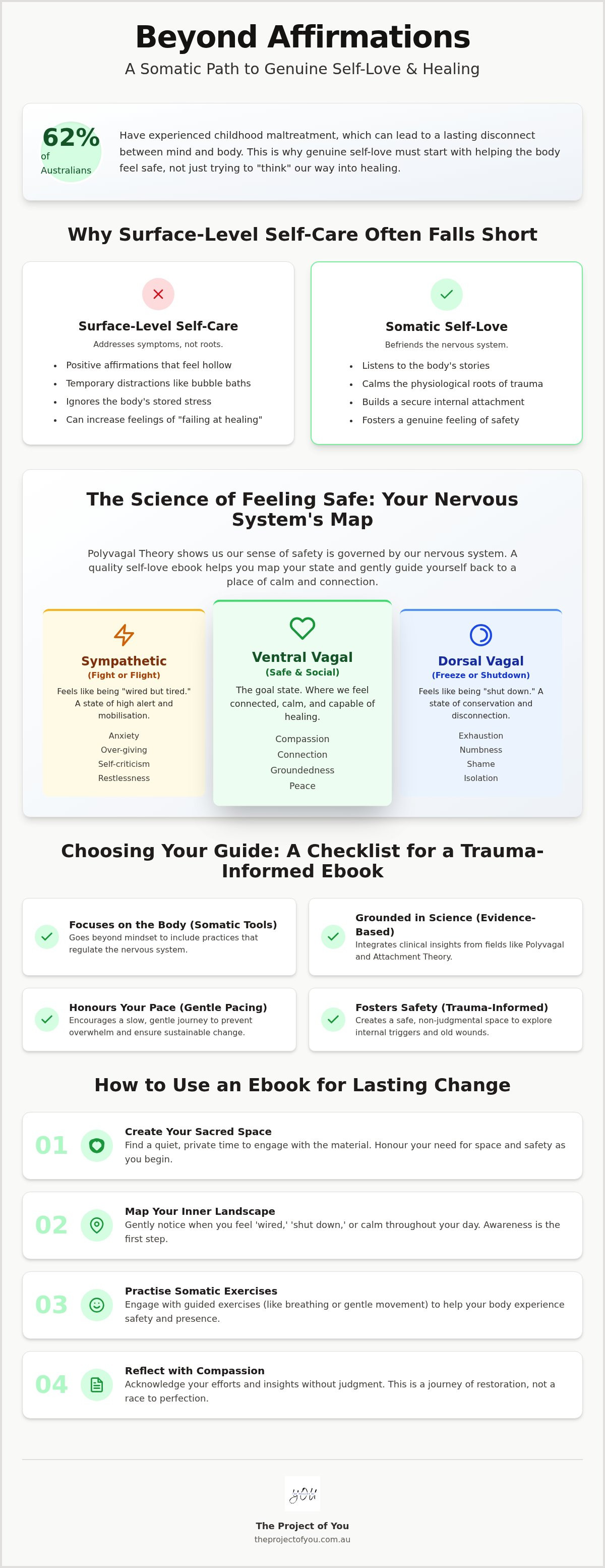
What if the reason you can't "think" your way into self-love is because your body hasn't been told it's safe to do so? For the 62 percent of Australians who've experienced childhood maltreatment, the internal landscape often feels more like a battlefield than a sanctuary. You might find yourself trapped in a cycle of chronic self-criticism, feeling as though you're failing at healing because surface-level affirmations just don't stick. It's a deeply exhausting way to live, especially when you're constantly over-giving to others while your own nervous system remains in a state of high alert.
I understand how frustrating it is to feel stuck in talk therapy without seeing the somatic progress you crave. This article promises to show you how to choose and use a self love ebook that goes beyond simplistic advice to foster deep nervous system restoration and secure internal attachment. We'll explore a structured path to feeling safe in your own body, practical somatic exercises that fit into a busy lifestyle, and a clear framework to help you understand your attachment style. It's time to move from surviving to a place of supported growth and genuine internal peace.
As a psychotherapist, trauma expert and founder of The Project Of You, Azita Abdollahian takes a trauma-informed approach to self-love, attachment and emotional healing. Her work recognises that developing a healthier relationship with yourself isn't simply about changing your thoughts. It can also involve understanding your nervous system, your attachment patterns and the experiences that shaped how safe you feel within yourself.
Table of Contents
What is a Self-Love Ebook and Why Does Your Journey Need One?
Imagine having a gentle, expert guide in your pocket, ready to sit with you whenever the world feels a bit too loud. A self love ebook isn't just a collection of digital pages; it's a structured companion designed for self-paced emotional restoration. For those navigating the aftermath of childhood trauma, the inner world can often feel like uncharted territory, full of hidden triggers and old shadows. Having a roadmap allows you to explore these spaces with a sense of safety and direction, ensuring you don't have to find your way alone.
When you're experiencing deep burnout or the heavy weight of shame, even making a phone call to a therapist can feel like a mountain too high to climb. Digital resources offer a quiet, accessible first step that respects your boundaries. They provide the "scaffolding" required for your personal evolution, offering a stable structure you can lean on as you begin to rebuild your sense of self. It's about creating a foundation of trust within yourself before moving into more intensive work.
The Difference Between "Self-Care" and Somatic Self-Love
We're often told that a bubble bath or a few positive affirmations will fix our low self-esteem. But why do these feel so hollow when you're grappling with deep-seated self-criticism? It's because surface-level self-care rarely reaches the physiological roots of trauma. Somatic self-love is different. It’s the intentional practice of befriending your nervous system and learning to listen to the stories your body is telling. By integrating clinical insights with daily practice, a well-crafted ebook helps you move from "knowing" you should love yourself to actually feeling that safety in your bones. This process is deeply tied to Attachment theory, as it helps you develop a secure internal bond that may have been missing in your early years.
Signs You Are Ready for a Self-Guided Healing Tool
How do you know it's time to reach for a dedicated resource? You might notice certain signals from your mind and body that suggest you're ready for deeper reflection:
Your "inner critic" has become a constant, draining narrator of your daily life, leaving you feeling "not enough."
You feel "wired but tired," stuck in a state of high alert yet completely exhausted by the effort of over-giving to others.
You feel a strong desire for privacy and control as you take those first, vulnerable steps toward change.
If you find yourself longing for a way to pace your own healing without the pressure of an immediate audience, a self-guided tool can be a beautiful way to begin. It allows you to honour your need for space while still receiving the professional guidance you deserve from a trauma-informed perspective.
The Science of Self-Compassion: Nervous System Regulation and Attachment
Have you ever wondered why, despite reading every self-help book on the shelf, that nagging voice of "not enoughness" remains? It's often because we're trying to solve a physiological problem with a purely psychological solution. Polyvagal Theory teaches us that our sense of safety is governed by the nervous system, not just the mind. If your body is stuck in a state of survival, your brain simply won't believe the affirmations you're trying to feed it. This is why nervous system restoration is so vital; it addresses the biological foundation of your well-being rather than just the symptoms of your distress.
Understanding Your Internal Safety Map
Think of your nervous system as having different "zones" that dictate how you interact with the world. When you're in a Ventral Vagal state, you feel connected, calm, and capable of self-compassion. However, chronic stress from childhood trauma often pushes us into "fight, flight, or freeze." In these states, feeling worthy feels like a foreign language. A high-quality self love ebook acts as a compass, helping you identify these physiological shifts throughout your day. By tracking when you feel "wired" or "shut down," you begin to map your own path back to internal peace. This awareness is the first step in shifting from a life of constant reaction to one of intentional action.
Attachment Theory and the Inner Critic
Our early relationships with caregivers act as the blueprint for how we treat ourselves today. If those bonds were unpredictable or lacked warmth, we might develop a harsh inner critic to keep us "safe" from further rejection. Instead of fighting this voice, we can learn to see it as a misguided protector that needs compassion, not combat. Extensive research on self-compassion suggests that treating ourselves with kindness is a key predictor of mental health and resilience. The Gottman Institute often speaks about building a "Sound Relationship House," and the very first level of that house is the secure relationship you have with your own self.
Trauma-informed resources are designed to gently unburden the shame that often accompanies these early attachment wounds. They don't ask you to "just be positive." Instead, they offer a space to be curious about your patterns without judgement. If you're ready to start this deeper exploration, you can book a session online to begin tailoring the tools in your self love ebook to your unique story. This partnership between self-guided study and professional support creates a powerful synergy for lasting change.
Evaluating Self-Guided Resources: A Checklist for the Conscious Reader
Choosing a self love ebook is a significant act of self-care, yet with so many digital shelves to browse, how do you know which guide will truly support your restoration? It's easy to feel overwhelmed by flashy marketing or promises of a "new you" in seven days. To find a resource that respects your history and your nervous system, you need a discerning eye. A high-quality guide should feel like a supportive partner, offering you the tools to navigate your inner world with grace and clinical integrity.
First, look for evidence-informed content rather than purely anecdotal stories. While personal journeys are valid, healing from childhood trauma requires a foundational understanding of how the brain and body respond to stress. Effective resources prioritise somatic exercises over simple cognitive reflections. If a book only asks you to journal about your feelings without helping you feel safe in your body, it's missing a vital piece of the puzzle. You need practical strategies that work within a busy Australian lifestyle, whether you're balancing a corporate career in the city or a hectic family life in the suburbs.
The "Red Flags" of Mainstream Self-Help
Many popular resources are actually "hustle culture" in disguise, pressuring you to work harder at your healing as if it were a productivity goal. If an ebook suggests you can "just think positive" to erase years of trauma, be cautious. This approach can be deeply dysregulating for a sensitive nervous system, as it often bypasses the very real physiological signals your body is sending. Avoid any resource that promises "guaranteed outcomes" or instant fixes. Genuine healing is a rhythmic, non-linear process that cannot be rushed or forced into a tidy timeline.
Identifying High-Quality Clinical Authorship
Who wrote the words you're inviting into your inner world? Seeking resources from a qualified Clinical Social Worker ensures the content is grounded in professional ethics and deep clinical experience. A trauma-informed author will never blame you for your struggles. Instead, they'll foster curiosity and encourage you to seek professional support alongside your self-study.
High-quality guides often align with established frameworks, such as APA or NICE guidelines, providing a sense of security and trust. This professional "scaffolding" allows you to explore your self love ebook with the confidence that you're in capable, compassionate hands. When a resource acknowledges the complexity of the human condition while offering a structured path forward, it becomes a truly transformative tool for your personal evolution.
Your Integration Template: How to Use a Self-Love Ebook for Lasting Change
Having a guide is one thing; knowing how to walk the path is another. To move from simply reading words on a screen to feeling a genuine shift in your bones, you need a plan for integration. A self love ebook works best when it's treated as a living document, a conversation between your current self and the person you're becoming. By following a structured template, you ensure that the insights you gain aren't lost to the busyness of daily life.
Create a "Sacred Space": Find a quiet corner of your home where you feel physically secure. This dedicated environment signals to your nervous system that it's safe to lower its guard and engage in deep somatic work.
Pace yourself: It's tempting to binge-read healing content in a quest for quick relief. However, true restoration happens in the pauses. Aim for one chapter or exercise per week to allow your body time to process the emotional shifts.
Pair cognitive prompts with grounding: Whenever you encounter a challenging reflection, immediately follow it with a physical grounding technique, such as feeling your feet on the floor or noticing the rhythm of your breath.
Use the "Reflective Question" method: Don't just answer prompts; sit with them. Let the questions percolate throughout your day to uncover deeper layers of self-understanding.
Organise your insights: Keep a dedicated journal to spot recurring emotional patterns. Seeing your progress written down helps build the "scaffolding" of your new, more compassionate self-narrative.
The Power of Reflective Inquiry
Reflective inquiry allows you to move from the analytical "Why am I like this?" to a more compassionate "How can I support this part of me right now?" For example, instead of judging a moment of anxiety, you might ask, "What does my body need to feel safe in this instance?" This shift in language fosters curiosity rather than criticism. Writing your responses down acts as a powerful tool for externalising your experience, allowing you to witness your own journey with the kindness of a steady mentor.
Managing Triggers During Self-Guided Work
Healing isn't always a smooth ascent. Sometimes, an exercise in your self love ebook might nudge you outside your "window of tolerance," leaving you feeling overwhelmed or shut down. Recognising these signals is a vital part of the process. If you feel your heart racing or a sense of numbness creeping in, use the "Stop, Breathe, Orient" technique. Stop the exercise, take a slow breath, and name three things you can see in the room. Knowing when to close the book and reach out for individual counselling is an act of profound self-respect, not a sign of failure.
Beyond the Ebook: Deepening Your Path to Restoration
While a self love ebook serves as an essential compass, there often comes a point where you feel ready to move from individual study to more immersive experiences. Think of your digital guide as a portal. It opens the door to a deeper understanding of your history, but the landscape beyond that door is best explored with a steady hand to hold. This is where the synergy between your personal work and professional guidance becomes truly transformative. Your self love ebook has laid the groundwork; now, let us help you build upon it.
By engaging with resources like The Healing Feminine Workshops, you can begin to refine the tools you've discovered. In these spaces, the theory of nervous system regulation translates into lived experience. You aren't just reading about safety; you are actively co-creating it within a supportive environment. This transition allows you to move from the intellectual "knowing" of self-compassion to a profound physiological "feeling" of being enough.
Immersive Experiences for Nervous System Restoration
There is a unique power in being seen and heard by a compassionate expert. While your ebook provides the "what" and "why," private and group retreats offer the "how" through direct somatic practice. Some parts of our healing require the presence of a "witness" to help us unburden the shame we've carried for decades. Moving from "learning" self-love to "embodying" it in a community setting allows your nervous system to experience a level of safety that is difficult to achieve in isolation. It’s about moving from the digital page into the rhythm of real-world connection and collective healing.
A Final Invitation to Your Future Self
What if you allowed yourself to be fully supported in this journey? For too long, you've likely felt the pressure to figure everything out on your own. At The Project of You, we act as your partner in navigating this personal evolution, providing the expert scaffolding you need to grow with grace. We believe that you are the most important project you will ever work on. Choosing to invest in your restoration is not an act of indulgence; it is a vital commitment to your future self. The path is open, and you don't have to walk it alone.
Embracing the Path to Your Whole Self
Healing from childhood trauma is a rhythmic journey of returning home to your own body. We've explored how genuine transformation requires more than just positive thoughts; it demands a deep befriending of your nervous system and a shift toward secure internal attachment. By choosing a trauma-informed self love ebook, you're providing yourself with a gentle map to navigate those complex inner landscapes at your own pace. You don't have to carry the weight of "fixing" everything at once. Small, somatic shifts and intentional reflection create the scaffolding for a life lived with more ease and less shame.
Azita Abdollahian and the team at The Project of You are here to support you through every transition. We offer clinical expertise and a shame-free space dedicated to nervous system restoration. You've already taken a courageous step by seeking a different way to live, and that curiosity is your greatest strength.
Begin your journey with our evidence-informed resources at The Project of You You are worthy of the time and tenderness it takes to heal. Your future self is waiting to meet you with open arms.
Frequently Asked Questions
Can a self-love ebook really replace regular therapy sessions?
A digital guide acts as a wonderful entry point or a supportive companion to clinical work, but it isn't a replacement for the nuanced, real-time connection found in regular therapy sessions. While an ebook provides structured tools and reflections, it cannot offer the personalised containment or professional assessment that a qualified therapist provides. It's best viewed as a compass for your daily journey, helping you maintain momentum between sessions or preparing you for deeper work.
How do I know if a self-love ebook is evidence-based and safe to use?
You can verify the safety of a resource by looking closely at the author’s professional credentials and the theories they reference. A high-quality self love ebook should be written by a qualified professional, such as a Clinical Social Worker, and grounded in evidence-based frameworks like Polyvagal Theory or Attachment Theory. Look for resources that avoid toxic positivity and instead prioritise nervous system safety, somatic grounding, and a clear understanding of childhood trauma.
What is the best way to use an ebook if I have a very busy schedule?
Integration is more important than speed when you're healing. If your Australian lifestyle is particularly hectic, try dedicating just fifteen minutes twice a week to a single exercise or reflection. You don't need to read the entire book in one sitting to see results. In fact, slow pacing allows your nervous system to process and integrate new concepts without feeling overwhelmed. Think of it as a gentle micro-practice that fits into your daily rhythm.
How does nervous system regulation help me love myself more?
Self-love is often impossible when your body is stuck in a survival state like fight or flight. Nervous system regulation helps you return to a state of physiological safety where self-compassion can actually take root. When your body feels safe, your brain is finally able to believe the kind words you say to yourself. It moves the process from an intellectual exercise to a lived, somatic experience of being worthy and secure in your own skin.
What should I do if the exercises in the ebook make me feel overwhelmed or triggered?
If you feel overwhelmed, the most compassionate thing you can do is pause immediately. Use the "Stop, Breathe, Orient" technique by noticing three things you can see and hear in your current environment to ground yourself. This reaction is a signal that you've moved outside your current window of tolerance. It's a sign that you might need the extra containment and support of individual counselling to process these deeper layers of trauma safely and effectively.
Are there specific Australian resources for self-love and emotional healing?
Australia has a robust network of trauma-informed support, including the resources offered here at The Project of You. Beyond our digital guides, you can access subsidised psychological care through the Better Access initiative by obtaining a Mental Health Treatment Plan from your GP. This allows you to combine self-guided tools with professional sessions. It's important to choose resources that understand the specific modern pressures and healthcare frameworks unique to living and working in Australia.
How long does it typically take to see changes from using a self-love guide?
Healing is a non-linear process, so there is no fixed timeline for transformation. Many people notice subtle shifts in their internal dialogue or their ability to self-soothe within the first few weeks of consistent use. However, deep-seated patterns from childhood trauma often take longer to unburden. Significant, lasting change usually emerges over months as you repeatedly practice somatic grounding and build a more secure internal attachment through the exercises in your self love ebook.
What is the difference between a self-love journal and a self-love ebook?
A self-love journal is primarily a space for your own reflections and thoughts, whereas a self-love ebook provides the clinical scaffolding and expert guidance to lead those reflections. The ebook offers the how and why behind your patterns, introducing psychological concepts like attachment styles and nervous system regulation. While a journal is a beautiful tool for witnessing your own experience, the ebook acts as the wise mentor that provides the structure and tools necessary for evolution.


Comments