

Communication Exercises for Couples to Make Talks Safer

What if better communication in your relationship started with listening rather than finding the perfect words? Communication exercises for couples can help you navigate conflict, understand each other’s needs and feel more emotionally connected. One effective technique is the speaker-listener exercise, where one partner speaks for three to five minutes without interruption while the other listens and reflects back what they heard. This creates space for understanding before jumping into solutions or defending your position.
If conversations often turn into arguments, leave one or both of you feeling unheard, or lead to emotional withdrawal, learning new communication skills can help. In this article, Azita Abdollahian, psychotherapist and Clinical Social Worker, shares practical communication exercises for couples, including reflective listening, managing emotional overwhelm, making clear requests without blame and reconnecting after conflict. You’ll also learn how to recognise emotional flooding, take constructive pauses and create safer conversations where both partners feel heard and respected. With consistent practice, these skills can help you move away from recurring arguments and towards healthier communication, greater emotional safety and stronger relationships.
Table of Contents
1. Speaker-listener technique and reflective listening
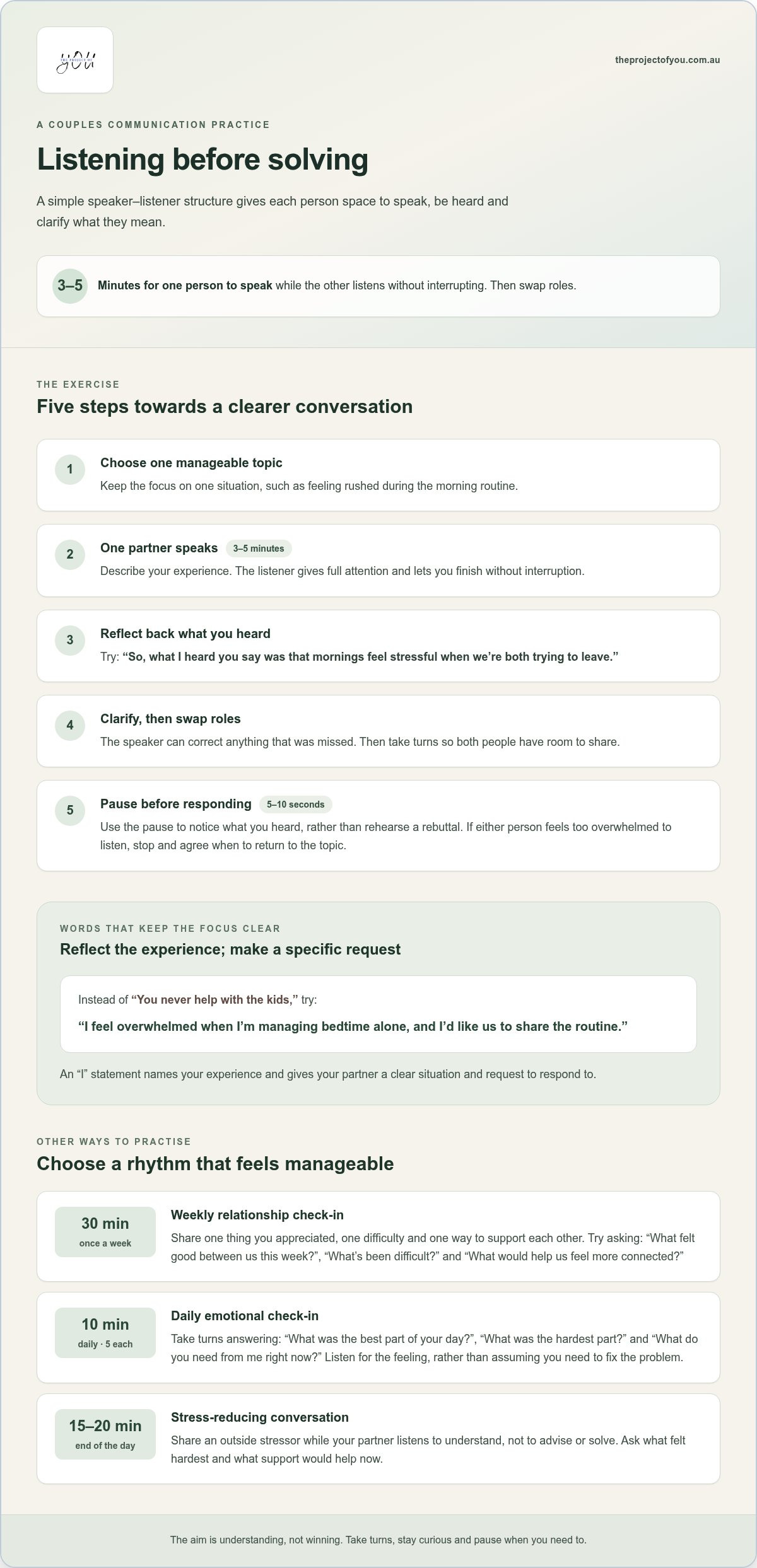
Effective communication exercises for couples include the speaker-listener technique, reflective listening and practising “I” statements. Try setting aside 3 to 5 minutes for one partner to speak while the other listens without interruption. Then switch roles. This structure gives each person a clear turn and helps the conversation stay focused on understanding, not winning.
Choose one manageable topic, such as feeling rushed during the morning routine. The speaker describes their experience while the listener gives their full attention, rather than preparing a reply. When the speaker finishes, the listener might say, “So, what I heard you say was that mornings feel stressful when we’re both trying to leave.” The speaker can clarify anything that was missed. This reflective dialogue helps separate what was said from what the listener assumed.
Active listening doesn’t mean agreeing with every detail. It means showing that you’re trying to understand your partner’s perspective before sharing your own. Try pausing, reflecting the main feeling or concern, and asking an open question. For example: “It sounds like you felt alone handling dinner. Have I understood that?” If your partner says you’ve missed something, listen again and offer a more accurate reflection.
Use “I” statements to describe your experience without turning it into an accusation. Instead of “You never help with the kids,” try, “I feel overwhelmed when I’m managing bedtime alone, and I’d like us to share the routine.” This gives your partner a specific situation and request to respond to. In a marriage, small wording changes can make a difficult subject easier to discuss without removing either person’s responsibility.
Pausing is part of the exercise, not a sign that you’ve failed. After your partner finishes, take 5 to 10 seconds before responding; use that moment to notice what you heard rather than rehearsing a rebuttal. Keep your voice steady, let your partner complete their thought, and reflect their meaning before offering your view. These listening skills can make a conversation feel more positive and give both partners room to speak. If either person becomes too overwhelmed to listen, stop and return to the topic when you can both engage.
2. What Are the Best Relationship Activities for Couples?
A weekly relationship check-in gives you a regular space to notice what’s happening between you. Set aside 30 minutes once a week, at a time when neither of you is rushing to work, preparing dinner or heading to bed. Treat it as shared attention, not a meeting to list everything your partner has done wrong. You might begin with one thing you appreciated this week, then discuss one difficulty and one way to support each other.
A simple structure can help keep a conversation balanced. Take turns answering: “What felt good between us this week?”, “What’s been difficult?” and “What would help us feel more connected?” Keep requests specific, such as asking for help with school lunches on busy mornings. If a topic needs more time, agree to return to it rather than letting the check-in become a long argument. The aim is to understand the relationship’s current needs and make room for small adjustments.
Daily emotional check-ins can be shorter and more immediate. Try 10 minutes daily, with 5 minutes for each partner to answer three questions: What was the best part of your day? What was the hardest part? What do you need from me right now? For example, one person might say they’re feeling stretched after a difficult workday and would appreciate company while making dinner. The other can listen for the emotional meaning, rather than assuming they need to fix the problem.
To deepen your understanding of each other, ask about something you haven’t discussed for a while. What hope are you holding for the coming year? What experience shaped how you approach family or work? You could revisit a first date, a family celebration or a small act of kindness, then ask what each person remembers differently. Keep the conversation curious, not a test of whose memory is correct.
Choose a small ritual of connection to make part of your week, such as sharing a cup of tea without phones or taking an evening walk. In a couples soul-gazing exercise, you hold eye contact for three to five minutes; either partner can look away or stop if it feels uncomfortable. The aim isn’t to perform closeness, but to notice what feels welcome and build connection at a pace that suits you both.
For a brief reflection, Naikan prompts you to consider what you received from your partner over the past 24 hours. You might recall that they made coffee or checked in before a stressful appointment. This can help you notice care in everyday interactions, without dismissing unresolved hurts. If regular check-ins feel difficult to begin, you can book a time to explore relationship support.
3. Stress-reducing conversations
A stress-reducing conversation makes room for each partner’s day without turning it into a problem-solving session. Set aside 15 to 20 minutes at the end of the day, especially when work, traffic or family demands are weighing on you. One partner shares an outside stressor, such as a tense meeting, while the other listens to understand. The listener’s role is not to give advice, find a solution or explain what the speaker should have done.
Try a clear listening structure: ask what happened, what felt hardest and what support would help now. You could say, “That sounds frustrating. What was the most difficult part?” or “Would you like me to listen, or help think through options?” Face the stressor together rather than turning against each other. For instance, “That traffic sounds exhausting. How can we make tonight easier?” signals that you’re on the same team.
Some couples use a longer version, with one partner listening for 20 minutes without offering advice or trying to fix the situation. The speaker might describe a disagreement with a colleague, while the listener asks open-ended questions and checks what they’ve understood. If the conversation shifts towards a relationship conflict, notice the change and agree whether to discuss it separately. This method can help you hear the emotional impact before making plans.
Dialectical behaviour therapy, or DBT, teaches practical skills for handling strong emotions and responding thoughtfully. You can adapt its STOP skill during a tense conversation: Stop, Take a step back, Observe what’s happening inside, then Proceed mindfully. If a comment about the dishes sparks irritation, for example, notice the urge to snap before choosing a calmer response. This isn’t about suppressing anger. It gives each person a moment to choose how to speak.
Conversation starters can help partners connect before discussing a stressful topic. Ask, “What’s something that made you smile today?” or “What’s one thing you’re looking forward to this week?” After a difficult day, keep the question specific and answer it yourself first. A small, genuine exchange can open the door to a fuller conversation without demanding immediate emotional depth.
After conflict, start a repair conversation with one concrete moment rather than a sweeping judgement. Try, “I’m sorry I interrupted you at dinner. I was frustrated, but I want to understand what you were saying.” Then ask what that moment was like for your partner and listen to their answer. You can acknowledge their feelings without agreeing on every detail. If either of you becomes overwhelmed, pause and decide when to return to the conversation.
4. Managing emotional flooding and taking timeouts
Emotional flooding is a moment when intense feelings make it difficult to stay present and respond thoughtfully. You might notice your voice getting louder, your thoughts racing or a strong urge to defend yourself. Recognising these signs can help you see when continuing the conversation is unlikely to be useful. Either partner can call a timeout without having to prove whose feelings are more valid.
Agree on a pause plan before a difficult discussion begins. Choose a phrase, such as “I need a break”, and decide how you’ll signal that you intend to return to the conversation. When either partner calls a timeout because of emotional flooding, spend at least 20 minutes apart. Use that time to settle rather than rehearsing what you’ll say next. A short walk, quiet breathing or noticing your surroundings may help you reconnect with the present moment.
A timeout works best with a clear plan to return. Before separating, say something like, “I care about resolving this. Let’s pause and check in again when we’re both ready.” If the agreed time arrives and either person still feels overwhelmed, say so honestly and choose another time to resume. This helps distinguish a pause from silently withdrawing or leaving the issue unresolved.
When you return, try identifying the feeling beneath your first reaction. For example, a disagreement about a changed plan might bring up disappointment, worry or feeling unimportant. An “I” statement can express that experience without deciding what your partner intended: “I felt anxious when I didn’t know the plan had changed.” Naming the emotion can help both people respond to what’s happening internally, rather than getting caught in a debate about blame.
Validation means showing that you’ve heard the emotional meaning of your partner’s words. You could say, “I can see why that change left you feeling unsettled,” even if you experienced the situation differently. Validation isn’t agreement with every conclusion. It recognises your partner’s experience while leaving room for your own. If conflict repeatedly follows the same painful pattern, emotionally focused therapy can help partners explore the attachment fears and needs beneath their reactions. A therapist may guide the conversation so each person can share vulnerable feelings and listen with care.
5. Behaviour change requests and mirroring
A behaviour-change request names one action you’d like to see, rather than judging your partner’s character. Try describing the situation, expressing your feeling, then asking for a specific change. For example, “When weekend plans change without a message, I feel unsettled. Could you text me when you know?” A clear request gives your partner something practical to respond to while leaving room for their perspective.
Keep each request focused on one behaviour. “Be more considerate” could mean many things, but “Could you let me know if you’ll be home later than planned?” is easier to understand. Avoid words such as “always” and “never”, which can turn one event into a debate about past mistakes. Choose a calm moment, explain why the change matters, and invite your partner to say what feels workable.
Mirroring helps you check whether your request has been understood as intended. After your partner speaks, reflect the main point in your own words: “You’d like a message if I’m running late, because waiting without knowing feels stressful.” Then ask, “Have I understood?” Your partner can correct or add detail before you respond. Mirroring isn’t repeating every sentence exactly, and it doesn’t mean you have to agree with every interpretation.
Feelings matter alongside the practical request. If your partner says, “I feel dismissed when you look at your phone while I’m talking,” you might reflect, “You feel unimportant when I keep checking messages.” Then acknowledge the emotional impact: “I can see why that would hurt.” This doesn’t mean accepting blame for everything. It shows you’re taking your partner’s feelings seriously before discussing your own experience.
Then switch roles. The listener can express their response with an “I” statement, such as, “I feel distracted when work messages arrive, and I can put my phone away during dinner.” Agree on a small action to try, and decide when you’ll revisit it. If either partner begins to interrupt or feels too overwhelmed to listen, use the agreed pause, then return to the request after 20 minutes or when you’re both ready.
Practise with a low-stakes request first, such as asking for a heads-up before inviting friends over. Notice whether each person can say what they need, reflect the other’s meaning and agree on a next step. If these conversations repeatedly become stuck, book support for relationship communication.
The Project of You | Trauma, Couples & Relationship Therapy Australia: Nervous System Regulation & Restoration
The Project of You | Trauma, Couples & Relationship Therapy Australia offers Nervous System Regulation & Restoration for people seeking support with stress and emotional regulation. If conversations repeatedly become overwhelming, or the exercises feel difficult to practise together, additional support can help you explore what happens in those moments and what might make communication feel safer.
Individual Counselling may suit you if you want space to understand your own responses before approaching a relationship conversation. The Healing Feminine Workshops and Self Love e-Books offer other ways to engage with reflection and personal growth. Choose support based on what feels relevant to your circumstances; you don’t need to have everything figured out first.
If you’d like to explore support, you’re welcome to contact The Project of You | Trauma, Couples & Relationship Therapy Australia.
Make room for a different kind of conversation
Change doesn’t have to start with a major relationship talk. Choose one moment this week when you both feel reasonably settled, and agree to approach it with curiosity rather than treating it as a test. Communication exercises for couples work best as shared practice: each person can notice what feels easier, what still feels tender and what they’d like to try differently next time.
If a familiar pattern keeps pulling you into the same painful exchange, it doesn’t mean either of you has failed. A supportive space can help you understand what lies beneath the pattern and practise responding with greater care. You can move at a pace that respects both partners’ needs and boundaries.
[Explore support for your relationship](https://www.theprojectofyou.com.au/book-online)
Every thoughtful pause and honest attempt to understand each other can create more room for connection. Keep taking the next step together, one conversation at a time.
Frequently Asked Questions
What Are the Best Relationship Activities for Couples?
The best activities make room for both enjoyment and honest conversation. Try cooking a new meal together, taking a walk without phones or planning a small shared goal, such as setting up a balcony garden. Afterwards, ask what each of you enjoyed and what you’d change next time. Choose activities that suit your energy and interests, rather than treating connection as another task.
What Causes Communication Barriers?
Stress, assumptions and past hurts can shape how partners hear each other. “We need to talk” might sound like a threat to one person and a practical opening to another. Different approaches to disagreement can also lead one partner to pursue answers while the other needs space. Naming the pattern without blame can help you work out what each person needs to stay engaged.
What If an Exercise Turns Into a Fight?
Stop the exercise if either person feels attacked, overwhelmed or unable to listen. Avoid following your partner from room to room or demanding an immediate resolution. Instead, say, “I want to continue, but I’m too upset to do this well right now.” Agree when to return to the issue, then use the pause to settle rather than rehearse counterarguments. If the same exercise repeatedly escalates, choose a simpler topic or seek guided support.
How can couples practise active listening at home?
Choose a low-pressure topic, such as deciding what to watch together, and practise giving your partner your full attention. Put devices aside, notice when you’re planning a reply, and bring your focus back to their words. Before responding, summarise the practical point and the feeling you noticed, then ask whether you understood correctly. This helps you learn how your partner wants to be heard before trying the skill during a more sensitive discussion.
What are simple daily communication exercises for partners?
Try a small daily gesture that invites connection without requiring a serious discussion. For example, send a message saying, “I’m thinking of you. How’s your afternoon going?” or share one detail from your day over dinner. You could also name something you appreciated, such as your partner sorting out a household errand. Keep it genuine and specific, and let your partner respond in their own way.
What questions can couples ask to improve communication and connection?
Ask questions that invite more than a yes-or-no answer. For example: “What’s been taking up most of your attention lately?”, “Is there something you’d like more help with?” or “What helps you feel close to me?” Take turns answering without correcting each other’s experience. If a question feels too personal in the moment, choose a lighter one and return to it when you both feel ready.
How can couples use a weekly relationship check-in exercise?
Use a check-in to notice patterns and agree on one manageable adjustment for the coming week. Each partner can name something they valued, raise one concern and suggest a practical next step. If evenings feel rushed, for example, decide together who will handle a particular household task. Finish by confirming what you’ve agreed, so neither person leaves with a different understanding of the plan.
What communication exercises help couples resolve conflict?
Conflict can be easier to work through when you discuss one specific event instead of revisiting every past disagreement. Each partner can describe what happened from their perspective, identify what mattered most, and suggest a repair or next step. After a tense conversation about family plans, for example, agree how you’ll make decisions together next time. If the discussion becomes unsafe or intimidating, prioritise safety and seek appropriate support rather than continuing the exercise.



Comments