

Conscious parenting support for Australian parents

What if becoming a more conscious parent wasn't about getting everything right, but about understanding your own reactions and recognising what your child needs in the moments that matter most? Conscious parenting is about developing greater awareness of your emotions, communication patterns and responses so you can parent with more intention, connection and understanding. For parents exploring conscious parenting in Australia, this approach offers a way to build stronger family relationships through emotional regulation, healthy boundaries and greater emotional awareness.
You might find yourself reacting more strongly than you intended, becoming frustrated during disagreements or repeating parenting patterns you experienced in your own childhood. This doesn't mean you're failing as a parent. Parenting can bring unresolved emotions and deeply ingrained responses to the surface. Learning to recognise these patterns can help you respond differently, without expecting yourself to be calm or patient every moment.
In this article, Azita Abdollahian, psychotherapist, Clinical Social Worker and relationship specialist, explores what conscious parenting means, how emotional regulation influences parent-child relationships and why self-awareness is an important part of raising emotionally healthy children. You'll also discover practical strategies for navigating conflict, communicating more effectively, setting healthy boundaries and creating a family environment where children feel heard, understood and supported.
Table of Contents
What is Conscious Parenting?
Conscious parenting means noticing your feelings and patterns, then responding with awareness of your child’s needs. In conscious parenting in Australia, the focus is on understanding what may be happening for a child while offering warmth, clear boundaries and steady guidance. Conflict still happens; the approach is about how you move through it together.
For example, if a toddler throws a toy, you might name their frustration, move the toy out of reach and stay close. That moment combines understanding with guidance.
Support across childhood stages
Parenting needs change, from newborn care to school routines and teenage independence. With a baby, support may focus on reading cues and coping with disrupted sleep. With a school-aged child, you might respond to a morning refusal with curiosity while keeping a consistent limit. A teenager may need you to listen first, then talk about expectations.
Look for guidance that considers your child’s development, abilities and individual needs. For strong-willed or neurodivergent children, this means adapting communication and expectations rather than treating every difference as defiance. A parenting coach or counsellor can help you explore practical strategies for specific challenges, including sleep difficulties or the effects of birth trauma.
Gentle and responsive parenting support
Gentle parenting prioritises respect and connection; conscious parenting also asks parents to examine their own triggers and childhood patterns. Responsive support helps you recognise a child’s feelings without removing boundaries. For instance, you can comfort a child who doesn’t want to leave the playground while still following through with the transition.
Holistic family support considers the child’s temperament, the parent’s capacity, family relationships and daily routines. One useful step is to identify a recurring flashpoint, such as bedtime, then notice what happens before, during and after it. Personalised coaching can turn those observations into guidance suited to your family.
How parenting approaches differ
Conscious parenting centres parental awareness and the relationship behind a behaviour. Gentle parenting emphasises respectful, compassionate interaction. Authoritative parenting is commonly described through warmth, clear expectations and consistent boundaries. These approaches can overlap: you can reflect on your reaction, speak kindly and still set a firm limit.
Support for conscious parenting in Australia can include parenting counselling, where you can explore communication, emotional patterns and practical responses. Consider whether you want support focused on your triggers, your child’s needs, or both. This can help you find guidance for a specific concern rather than general advice.
Benefits and limitations
Conscious parenting may help you pause, understand your reactions and repair after conflict. It can encourage connection without treating a child’s upset as bad behaviour. The approach doesn’t guarantee a particular outcome; its value lies in helping you reflect on how your responses affect family interactions. Notice whether a strategy fits your child’s needs and works in your family’s circumstances.
Common criticisms include making parents feel responsible for every difficulty, or confusing empathy with permissiveness. Children still need adults to provide guidance and boundaries. Consistent practice takes time and energy, especially when sleep issues, birth trauma or family stress are present. If reflection becomes self-blame, or conflict keeps repeating, personalised professional support can help you examine the pattern with care.
Mindful parenting and emotional regulation
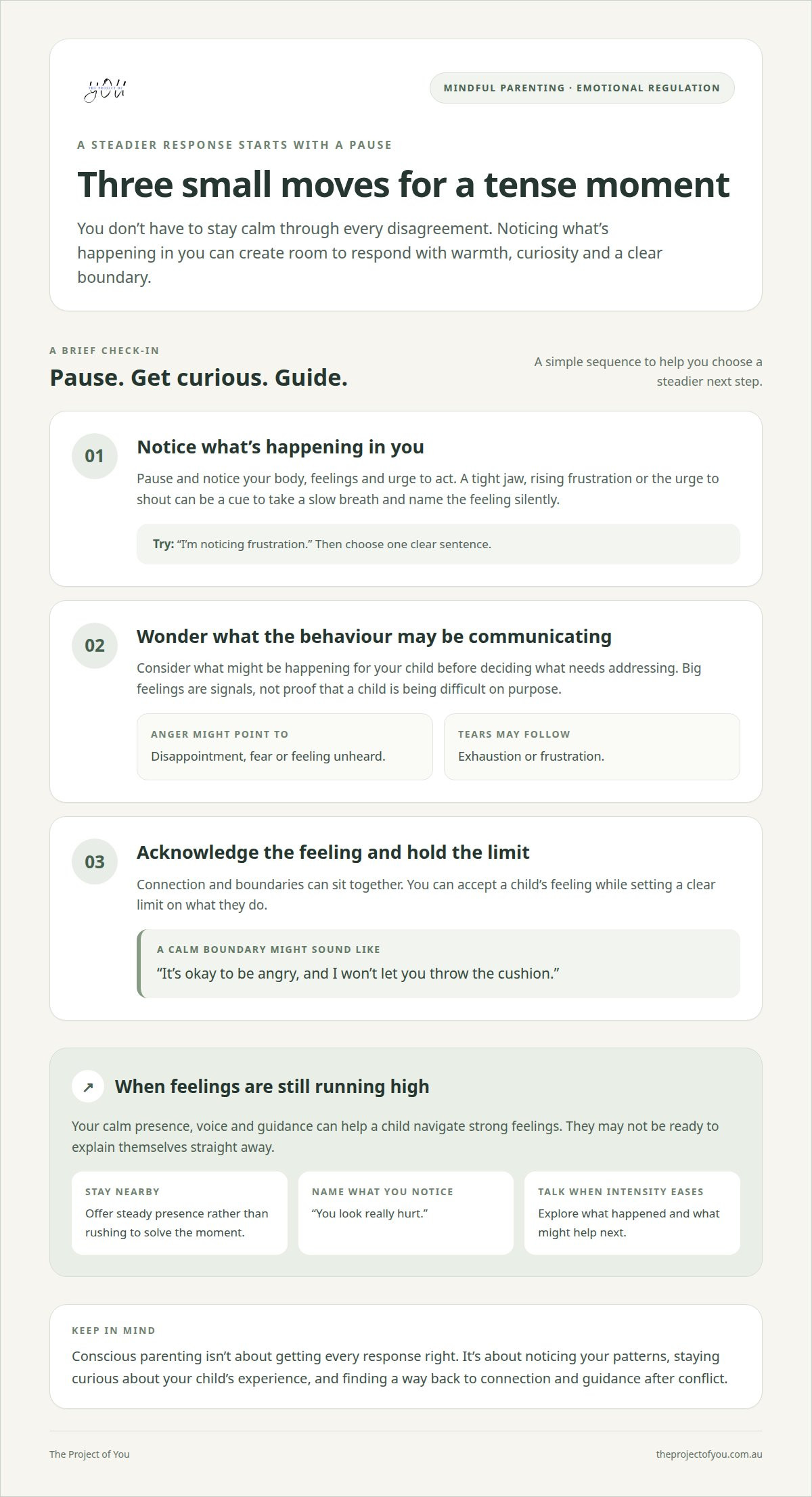
Mindful parenting creates a pause between a child’s behaviour and your response. That pause can help you notice your feelings, understand what they signal and choose a steadier next step.
Mindfulness and emotional regulation
Emotional regulation means recognising feelings and finding ways to respond without letting them dictate every action. Mindfulness brings attention to what’s happening now: a tight jaw, rising frustration or the urge to shout. In a difficult moment, try naming the feeling silently, taking a slow breath and choosing one clear sentence. If homework becomes tense, pause before discussing the unfinished task.
Co-regulating emotions
Co-regulation is when a parent helps a child navigate strong feelings through their presence, voice and guidance. A child upset after a disagreement with a sibling may not be ready to explain themselves straight away. Stay nearby, speak calmly and acknowledge what you notice: “You look really hurt.” Once the intensity eases, help them consider what happened and what might help next.
Big emotions are signals, not proof that a child is being difficult on purpose. Anger might point to disappointment, fear or feeling unheard; tears may follow exhaustion or frustration. Notice the context before deciding what behaviour needs addressing. You can accept the feeling while setting a limit on actions, such as saying, “It’s okay to be angry, and I won’t let you throw the cushion.”
Your feelings matter too. If a child’s shouting brings a sudden surge of anger, notice what happens in your body before responding. Your history, stress and current capacity can shape how a moment feels. A trauma-informed approach makes room for those influences without assuming every strong reaction has the same cause. Self-awareness can help you separate the present situation from an earlier experience.
Try this brief check-in during a tense interaction:
Pause and notice your body, feelings and urge to act.
Ask what the child’s behaviour might be communicating.
Offer a calm boundary or support that fits the moment.
Return to the conversation when you can both listen.
If your reactions feel difficult to shift, parenting support can help you explore emotional patterns and practise regulation strategies that suit your family.
A strong emotion can be understood as a signal that something matters, rather than as something inherently bad. Children gradually learn to manage emotions through their experiences, relationships and developing nervous systems. Keeping this gradual process in mind can help you respond to the moment without expecting a child to manage every feeling independently.
Self-paced learning resources can cover parenting challenges such as big feelings, routines and staying calm under pressure. Exploring these topics at your own pace can help you reflect on common situations and the challenges that arise in family life.
Conflict resolution, connection and communication
Conflict can become a chance to practise listening, boundaries and repair. A connected approach combines emotional presence with clear adult guidance.
Connected boundaries without punishment
A connected boundary names what must stop and what help is available. If a child hits during a sibling dispute, move between them and say, “I won’t let you hit. You seem upset, and I’m here to help.” This protects everyone while recognising the child’s feelings. You don’t need punishment to make the limit clear.
Structure matters too. Children can feel safer when routines and expectations are predictable, such as putting devices away before dinner. Explain the limit in simple language, then follow through calmly. If your child protests, listen to their frustration without turning the boundary into a negotiation. Connection and adult leadership can go hand in hand.
In the moment, try to:
Describe the behaviour without labelling the child as “naughty”.
State the boundary clearly and briefly.
Offer an acceptable next step, such as taking space or asking for help.
Return to the issue when everyone can listen.
This shifts the focus from making a child feel bad to helping them learn what to do next. A boundary remains meaningful when it is kind, consistent and easy to understand.
Connection before correction
When a child is overwhelmed, correction may not land until they feel heard and safe. Start by being present: lower your voice, come to their level if appropriate, and acknowledge what you notice. For example, after a rushed school morning, saying, “You’re frustrated that we have to leave” can open a conversation more gently than a lecture.
Once your child is calmer, describe the impact and guide the next step. You might say, “The shouting made it hard for me to understand. Try telling me what you need in a quieter voice.” This keeps communication focused on behaviour and learning, rather than shame.
Repair matters after a parent loses patience, too. A brief apology, such as “I spoke sharply; I’m sorry. Let’s try again,” models accountability without removing the original boundary. Children learn from seeing adults take responsibility and reconnect after conflict. The aim isn’t to avoid every rupture, but to make room for listening, understanding and a healthier way forward.
Challenges for parents with different personalities
Parents can share the same values and still respond differently under pressure. One may want to discuss a child’s refusal immediately; the other may need quiet before talking. These differences can create tension, especially when each person believes their approach protects the family.
Personality shapes how adults respond to everyday challenges. A parent who values order may prefer firm routines, while a more flexible parent may adapt plans as the day unfolds. Neither style automatically makes someone a better parent. The useful question is what the child needs in that moment, and how both adults can provide guidance without undermining each other.
Try separating the immediate issue from the difference between you. If one parent wants a child to finish chores before screen time and the other is comfortable delaying them, pause the debate in front of the child. Agree on a simple response for today, then revisit the broader expectation privately. This prevents a disagreement about parenting style from becoming another conflict for the child to navigate.
A brief shared plan can build confidence without requiring identical personalities. Choose one recurring situation, such as leaving a friend’s house, and discuss:
What boundary needs to stay consistent, such as leaving when agreed?
Where can each parent use their own style, such as offering a choice of shoes?
What phrase will both use if the child protests, such as, “It’s time to go; would you like to walk or hold my hand?”
This kind of agreement gives a child a clearer sense of what’s coming. It also leaves room for warmth, humour or quiet reassurance, depending on the adult. Review the plan afterwards: what helped, what felt difficult, and what might change next time?
Different backgrounds can shape those reactions. A parent raised with strict rules may feel anxious when a child pushes back; someone who experienced little structure may find firm limits uncomfortable. Naming the feeling without blaming each other can shift the conversation: “I feel worried when the routine changes” is easier to work with than “You’re too soft.”
Aim for a workable shared direction, not perfect agreement. If disagreement keeps spilling into arguments or leaves one parent feeling alone, set aside a calm time to listen and identify one change to practise. You don’t have to agree on every parenting choice to show up with respect, consistency and care. What matters is how you handle the difference together.
Conscious parenting and responding rather than reacting
Responding rather than reacting means creating space to choose your next action, even when you feel overwhelmed. Practical techniques can help you notice your own cues, understand what’s happening and respond in ways that support your relationships.
Responding instead of reacting
A reaction can arrive quickly: your toddler refuses to get dressed, and you hear your voice rising. A response begins with noticing that surge before deciding what to say. You might put both feet on the floor, soften your shoulders and say, “We’re having a hard start. Let’s choose clothes together.”
This isn’t about suppressing anger or getting every moment right. It’s about recognising the feeling and choosing a next step that fits your values. Ask yourself: “What needs attention now, and what can wait?” That question can shift your focus from stopping behaviour immediately to understanding the need while keeping a boundary.
If you react sharply, return when you’re ready. You could say, “I was frustrated and spoke too loudly. I’m sorry. We still need to leave, and I’ll help you.” Repair acknowledges your part without asking a child to manage your feelings. It also shows that relationships can hold mistakes, responsibility and reconnection.
Practical conscious parenting techniques
Australian parents can use simple techniques during everyday pressure points. The useful measure isn’t whether conflict disappears, but whether you can respond with more awareness and clearer guidance. Choose one technique to practise in a familiar situation, such as packing school bags or ending a game.
Name your cue: Notice a clenched jaw, a fast voice or the urge to threaten a consequence.
Pause briefly: Take a breath, lower your voice or step back when the child is safe.
Describe what you see: “The bag is still unpacked,” rather than “You never listen.”
Offer a clear next step: “Put your lunchbox on the bench, then we’ll check your reader.”
Reflect afterwards: Consider what helped, what overwhelmed you and what you’ll try next time.
If a teenager misses an agreed household task, begin with a neutral observation and ask what got in the way. Then restate the expectation and agree on a practical time to complete it. Curiosity doesn’t remove accountability; it makes room for information before deciding what to do next.
Parenting support can help when the same reactions keep returning or family stress makes these steps difficult to practise. Start by tracking a recurring trigger and the response you’d like to try instead.
[Explore parenting support](https://www.theprojectofyou.com.au/book-online)
The Project of You | Trauma, Couples & Relationship Therapy Australia: Nervous System Regulation & Restoration
The Project of You | Trauma, Couples & Relationship Therapy Australia offers Parenting Counselling for parents seeking support with recurring family tensions, emotional triggers or a more considered response to conflict. Individual Counselling can also give you space to explore how your own experiences shape the way you parent.
When stress feels hard to settle, Nervous System Regulation & Restoration can help you build awareness of your responses and practise ways to steady yourself. This may be useful when familiar patterns return or you want support finding an approach that fits your family’s needs. You can begin with a specific challenge, such as arguments around routines, and explore what might help you respond differently.
If you’d like to explore support, you’re welcome to visit The Project of You.
Take the next step at your own pace
Change often begins with one small choice: noticing a familiar reaction, pausing before you speak or returning to a conversation after a difficult moment. You don’t need to reshape your whole family life at once. Choose one situation that matters to you and consider what you’d like to do differently next time.
If you’re exploring conscious parenting in Australia, counselling can offer a thoughtful space to understand what lies beneath recurring patterns and decide what feels practical for your family. Seeking help isn’t a judgement on your parenting. It can help you approach this part of your journey with greater understanding.
[Explore support for your next step](https://www.theprojectofyou.com.au/book-online)
Every family’s path has its own pace. With curiosity and care, you can keep building a way forward that feels more connected and true to your values.
Frequently Asked Questions
What does conscious parenting mean?
In practice, conscious parenting can mean building a small pause into a familiar routine, such as the trip home from school. Instead of immediately asking about homework, notice whether your child needs quiet, a snack or conversation first. Later, you can return to the afternoon’s responsibilities with a clearer sense of what support might help. This turns awareness into an everyday parenting choice.
What are the core principles of conscious parenting?
Core principles include self-awareness, emotional presence, respect for a child’s feelings, and clear, consistent boundaries. Practise noticing your reactions, listening to your child’s perspective and taking responsibility when you make a mistake. For instance, after interrupting your child as they explain a disagreement, acknowledge it and invite them to finish. These principles offer a flexible guide for everyday choices, not a standard you must meet perfectly.
Are conscious parenting courses or coaches available in Australia, and how much do they cost?
Parents in Australia can explore courses, coaching and counselling focused on parenting challenges. Options differ in format and focus: a course may teach general skills, while individual support can address a family’s particular concerns. Conscious parenting in Australia may be supported through Parenting Counselling, including space to explore family dynamics. Costs vary according to the service, format and individual circumstances; ask about these factors when considering a specific option.
How can parents practise conscious parenting during tantrums and conflict?
During a tantrum, focus first on safety and reducing extra demands. For example, in a supermarket, move away from a crowded aisle if possible, use a few calm words and avoid asking several questions at once. Once your child can engage, offer a simple choice, such as holding your hand or sitting in the trolley. Later, consider whether hunger, noise or a change in plans added strain.



Comments