

Dating someone with an avoidant attachment style: causes and patterns

What does dating someone with an avoidant attachment style look like, and why can emotional closeness sometimes lead to distance? Avoidant attachment can develop when early experiences make it difficult to feel safe expressing emotional needs or relying on others. In adult relationships, this may show up as discomfort with vulnerability, a strong need for independence or withdrawing when intimacy deepens. For a partner, the shift between moments of connection and periods of emotional distance can feel confusing, lonely or difficult to understand.
If you’re dating someone with avoidant attachment, you may find yourself questioning how they feel about you or wondering how to reconnect when they pull away. Understanding attachment patterns can help you make sense of these behaviours without labelling or blaming your partner, while recognising that your own emotional needs matter too. In this article, Azita Abdollahian, psychotherapist and Clinical Social Worker, explores the causes of avoidant attachment, how it can affect dating and romantic relationships, and how to communicate more effectively when one partner seeks closeness while the other needs space. You’ll also learn how to express your needs, establish healthy boundaries and build emotional safety without losing sight of your own wellbeing.
Table of Contents
1. Am I Dating Someone with an Avoidant Style?
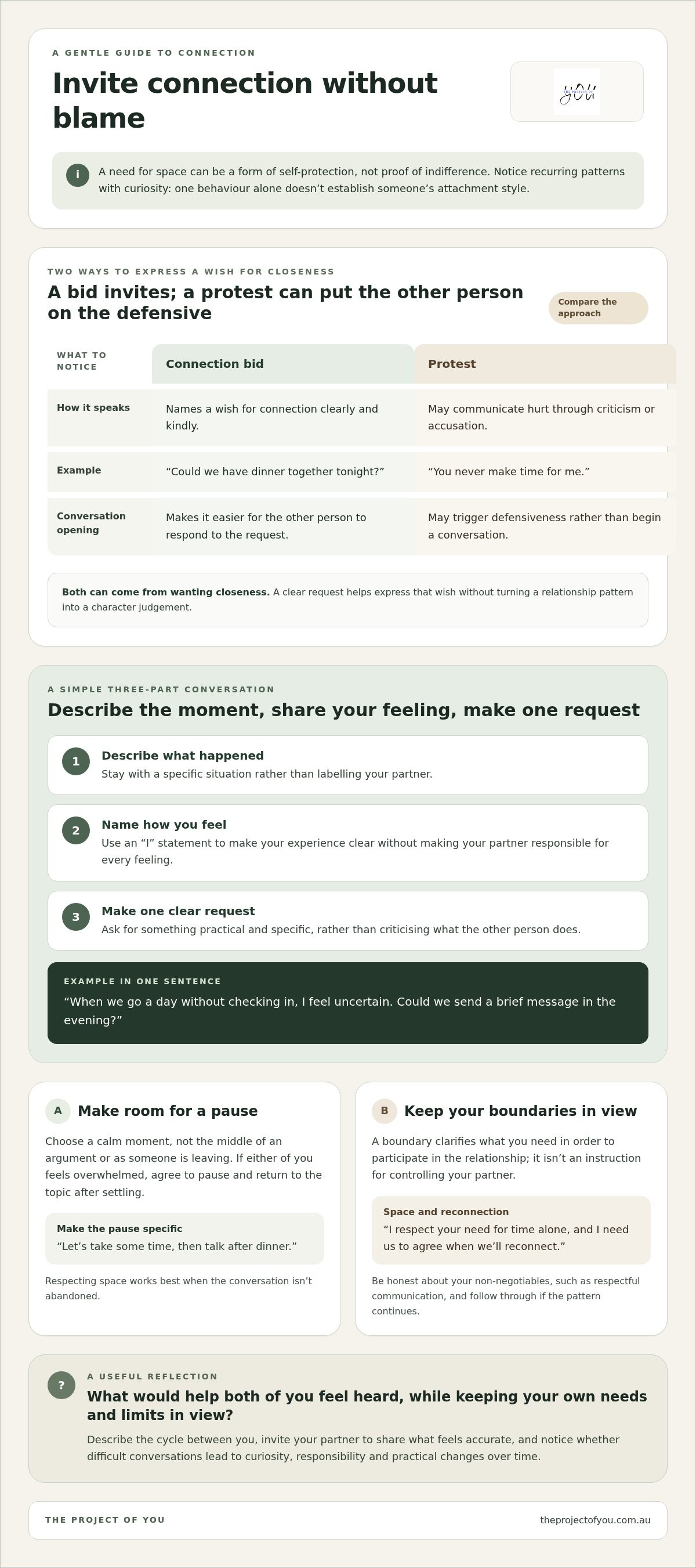
Communicate calmly, describe a specific moment and make a clear request without assigning blame. For example: “I feel disconnected when plans change without a conversation. Could we agree to update each other?” Dating someone with an avoidant attachment style can feel confusing, but a direct, respectful conversation gives you both a chance to explain what’s happening.
One behaviour doesn’t establish someone’s attachment style. Look for a recurring pattern instead: perhaps they enjoy spending time together but pull back after an emotional conversation, or prefer to manage problems alone. These behaviours can have different explanations, so focus on what happens between you rather than diagnosing them.
Notice the difference between a bid and a protest. A bid invites connection, while a protest often communicates hurt through criticism or accusation. “Could we have dinner together tonight?” is a bid. “You never make time for me” is more likely to trigger defensiveness than start a conversation. Both may express a desire for closeness, but the first makes it easier to respond.
Try a simple three-step approach: describe the situation, share your feeling, then make one request. “When we go a day without checking in, I feel uncertain. Could we send a brief message in the evening?” This kind of “I” statement is clear and assertive without making your partner responsible for every feeling you have.
Choose a calm moment to raise concerns, rather than bringing them up during an argument or as someone is leaving. If either of you feels overwhelmed, agree to pause and return to the topic after settling. Make the pause specific: “Let’s take some time, then talk after dinner.” Respecting space works best when the conversation isn’t abandoned.
Boundaries clarify what you need to participate in the relationship; they aren’t instructions for controlling your partner. You might say, “I respect your need for time alone, and I need us to agree when we’ll reconnect.” Be honest about your non-negotiables, such as respectful communication, and follow through if the pattern continues.
Take your own attachment style into account, too. If distance makes you urgently pursue reassurance, pause, notice your feelings, and consider what would help you feel grounded before speaking. If you’re dating someone with an avoidant attachment style, a low-pressure shared activity, such as a walk, can offer connection without requiring an intense conversation. Both people can practise making room for closeness and independence.
2. Naming relationship patterns without blaming a partner
Describe the cycle between you rather than defining your partner by it. For example: “When stress comes up, you go quiet, I stop raising it, and the issue stays unresolved.” This names observable actions and their effect. Calling someone “cold” or “selfish” turns a relationship pattern into a character judgement, making curiosity harder.
Attachment language can help people discuss different responses to closeness, as long as it stays descriptive. You might share, “I notice I seek reassurance when we feel distant. I wonder if you need more space then.” Invite your partner to say what feels accurate to them. A label isn’t a diagnosis, and neither person has to accept a description that doesn’t fit.
A secure base outside the relationship can help you stay connected to your own life while working through uncertainty. Keep a meaningful friendship active, make time for a hobby, or maintain routines that bring steadiness. These aren’t ways to punish yourself by becoming less dependent. They give you more than one source of connection, meaning and comfort as you consider what you need from the relationship.
Assess growth by noticing what happens after a difficult conversation. Does each person show curiosity, take some responsibility and try a different response next time? Progress doesn’t mean having no conflict. It can mean returning to an unresolved issue, listening with less defensiveness or agreeing on a practical change. A desire to grow matters most when it shows up in repeated actions, not only promises.
When both people lean towards independence, a relationship may feel calm and spacious at first. Over time, though, each might avoid initiating emotional conversations, leaving important needs unspoken. Try agreeing to check in about one shared concern, such as how you handle plans or repair misunderstandings. The aim isn’t to force closeness; it’s to see whether both can make room for it.
Consider your thresholds: what would need to change for this relationship to feel respectful and mutual? If you’ve named your needs, made room for discussion, and still experience persistent emotional distance or unmet needs, leaving may be a considered choice. Love and capacity aren’t always the same; a partner may care and still be unable to offer the relationship you need.
Individual counselling can help you explore your own attachment responses, boundaries and choices without taking responsibility for changing someone else. If you’d value support thinking this through, you can book an individual counselling session.
3. What Causes an Avoidant Attachment Style?
Avoidant attachment may develop when a child’s emotional needs aren’t consistently met. They may learn to rely on themselves if asking for comfort brings little response or feels unwelcome. This is one possible pathway, not a conclusion about any particular person’s childhood. John Bowlby’s foundational work on attachment explored how early relationships can shape expectations about care and closeness. These ideas offer context, not a way to diagnose someone from their dating behaviour.
For example, a child who is often told to stop crying may begin hiding sadness rather than seeking comfort. As an adult, they might find it difficult to ask for reassurance, even when they value a close relationship. This example illustrates a possible link between early experiences and later responses; it doesn’t prove what caused an individual’s behaviour. Temperament and later relationships also contribute to how people approach intimacy.
Attachment isn’t a fixed verdict on someone’s capacity for connection. People may respond differently across relationships and situations. A secure attachment style involves being more able to balance closeness with independence. Attachment theory provides a useful way to reflect on these responses, but it shouldn’t become a label that limits someone’s potential. Self-awareness and experiences of respectful, dependable communication can support new ways of relating.
Couples therapy can help partners examine their shared pattern instead of deciding who is at fault. A therapist might help each person notice what happens during conflict: one asks for reassurance, the other withdraws, and both feel misunderstood. Slowing that sequence down can create space to practise listening, naming needs and returning to a conversation after a pause. The aim is to support a more secure connection, not to force closeness.
Individual therapy may help someone explore their own responses, history or discomfort with relying on others. For instance, they might examine why sharing disappointment feels unsafe, then practise expressing it in manageable steps. Couples work focuses on the interaction between partners; individual work offers room to explore personal experiences privately. Either approach can support reflection, depending on what the person or couple wants to address.
If you’d like to encourage therapy, frame it as an invitation rather than a demand. You could say, “I care about us, and I’d like help understanding how we handle conflict. Would you consider talking with someone together?” If your partner isn’t ready, you can still seek individual support for your own needs and choices. Their decision is theirs; your wellbeing remains yours to attend to.
Begin with one shared question: “What helps each of us feel safe enough to stay in a difficult conversation?” Agree on a practical step, such as taking a pause and setting a time to return. Notice whether both people make room for repair. Repeated efforts towards openness and accountability matter more than adopting an attachment label.
4. Physical intimacy without emotional vulnerability
Physical affection and emotional openness don’t always develop at the same pace. A partner may enjoy cuddling or sex yet find it difficult to discuss fears, needs or disappointment. That difference can leave you feeling close in one moment and alone in another. It describes an experience, not proof of anyone’s attachment style.
The risks of dating someone who seems emotionally unavailable include feeling lonely, doubting your importance or carrying most of the emotional work. If difficult conversations repeatedly stop before concerns are addressed, resentment can build and trust may become harder to sustain.
Emotional expression can feel unfamiliar or exposing for someone who has learnt to manage distress privately. During a tense conversation, they might go quiet, change the subject or offer a practical fix instead of naming feelings. For example, they may arrange transport after a hard day but struggle to say, “That sounds painful. I’m here.” Practical care can matter, while emotional presence may still be needed.
Attunement means trying to understand what an emotion is communicating, rather than rushing to correct it. If your partner shares, “I felt hurt when you cancelled,” you might first reflect, “You were looking forward to seeing me, and the change stung.” That response doesn’t require agreement about every detail. It shows you’re listening before explaining your perspective.
When your partner does open up, make space for their words. Let them finish, avoid interrupting or immediately defending yourself, and ask a gentle question, such as, “What was that like for you?” You could add, “Thanks for telling me.” Validation recognises the feeling as real; it doesn’t mean accepting blame or fixing the problem on their behalf.
If they struggle to comfort you, be specific about what support would help. “I don’t need a solution yet. Could you sit with me and listen for a few minutes?” is clearer than hoping they’ll guess. If they respond with advice, you can acknowledge the effort and restate your request. Notice whether they make room for this need over time.
Your wellbeing matters alongside your partner’s discomfort. Keep a friend, activity or routine that helps you feel grounded, and notice whether the relationship makes space for your feelings too. You can offer patience without becoming the only person tending to the connection. If physical intimacy continues while emotional conversations are consistently avoided, consider what you need for a healthy relationship and whether both of you are willing to address the gap.
5. Avoidant attachment and deactivating strategies
Avoidant attachment can shape romantic relationships when closeness feels uncomfortable or threatens a person’s sense of independence. During stress, one partner may seek reassurance while the other creates distance, leaving both feeling misunderstood. This push-pull pattern can make emotional connection harder, even when both people care about the relationship.
Deactivating strategies are ways of turning down attachment needs when closeness or dependence feels risky. Someone might focus on a partner’s flaws after a tender moment, become absorbed in work or insist they don’t need anyone. These responses may feel protective to them, but their impact can still leave a partner feeling shut out.
Look for repeated actions, not one quiet evening. A partner might ask for space after conflict, avoid discussing future plans or compare the relationship with an idealised past one. Such behaviours can reflect a perceived threat to autonomy; they don’t, by themselves, reveal how much someone cares. Notice whether they can return to connection after taking space.
When a partner withdraws or needs space, acknowledge the request and agree on how you’ll reconnect. You could say, “I’ll give you tonight to think. Can we talk tomorrow after work?” A clear plan respects their need for distance while protecting your need not to leave an important conversation unresolved indefinitely.
During conflict, regulate your own response before trying to resolve the issue. Take a walk, slow your breathing or write down the concern you want to raise. Then address one specific behaviour rather than repeatedly pursuing reassurance. If either person needs a pause, agree to resume when both feel calmer; taking space works best when it doesn’t become avoidance without repair.
Repeatedly raising the possibility of a breakup, withdrawing affection or acting fiercely independent can unsettle trust. These actions may be attempts to regain control when closeness feels threatening, but they can create uncertainty for both partners. Discuss their effect without assuming intent: “When you mention ending things during arguments, I feel unsure whether we’re working through this together.”
Keep the relationship from becoming a fixed script where one person always pursues and the other always retreats. Each partner can name what happens inside them: “I get anxious when plans feel uncertain,” or, “I feel pressured when we need an answer straight away.” Those experiences can guide a conversation about manageable steps towards connection and independence.
Notice whether both people can reflect, take responsibility and make changes after a difficult moment. One person can’t do this work for two. Consider what you need if the same cycle continues, and make relationship decisions when calm rather than emotionally activated. A relationship with someone who needs space can still include care and repair, but your boundaries and wellbeing matter too.
[Book relationship support](https://www.theprojectofyou.com.au/book-online)
The Project of You | Trauma, Couples & Relationship Therapy Australia: Nervous System Regulation & Restoration
The Project of You | Trauma, Couples & Relationship Therapy Australia offers Nervous System Regulation & Restoration for people seeking support with stress and relationship patterns. If attachment-related distance or conflict feels difficult to understand, individual counselling can help you explore your responses, needs and boundaries in a supportive setting. The focus is on building self-awareness and finding practical ways to respond, rather than labelling or blaming either partner.
Support may be helpful when the same relationship cycle keeps returning, or when conversations leave you feeling overwhelmed or disconnected. You can also explore The Healing Feminine Workshops and Self Love e-Books as educational resources for reflection and personal growth.
If you’d like to explore support, contact The Project of You | Trauma, Couples & Relationship Therapy Australia or visit theprojectofyou.com.au.
Choose a next step that honours your needs
Dating someone with an avoidant attachment style can invite you to look closely at what you need to feel connected, respected and emotionally safe. You don’t have to decide the whole future of the relationship today. Start by noticing whether both of you can make room for honest conversations, repair and change.
Try asking yourself: what would help me feel more secure in this relationship, and what am I willing to do to support that? Your answer can guide a calm conversation, a personal boundary or a decision to seek support. Compassion for your partner doesn’t mean setting aside your own wellbeing. You’re allowed to want closeness and consistency.
If you’d like space to explore your relationship patterns and possible next steps, individual counselling can offer a supportive place to begin.
[Book an individual counselling session](https://www.theprojectofyou.com.au/book-online)
Move at a pace that feels thoughtful and true to you. Greater clarity can begin with one honest step.
Frequently Asked Questions
What Causes an Avoidant Attachment Style?
Avoidant attachment may develop when a child learns that showing emotional needs doesn’t reliably bring comfort. For example, they may stop asking for help after repeated experiences of being dismissed. This is one possible pathway, not a conclusion about any particular person’s childhood. Temperament, later relationships and life experiences may also shape how someone responds to closeness. Ask about their experiences with openness, not to prove a theory.
Am I Dating Someone with an Avoidant Style?
You can’t know someone’s attachment style from one behaviour, and a partner’s label isn’t yours to assign. Consider whether a repeated pattern appears across situations: for instance, they may be warm during casual plans but disengage whenever you discuss commitment. Ask how they experience those moments, then compare their answer with their actions over time. The question isn’t only which style fits, but whether the relationship can make room for both people’s needs.
How Do I Date Someone With Avoidant Attachment Without Destroying Myself?
Protect your sense of self by keeping your routines, friendships and personal goals active while building the relationship. For example, don’t cancel a regular catch-up with a friend every time your partner becomes distant. Notice whether you’re constantly monitoring messages or changing your needs to prevent discomfort. A journal can help you record what happened, how you felt and what you need next. This supports clearer choices without making your partner responsible for your wellbeing.
What To Do About It?
Start with one clear conversation about a specific situation and the change you’d like. For example, if plans often remain uncertain, ask to decide together before making other commitments. Listen to your partner’s perspective, then agree on a practical next step you can both try. Later, notice whether the agreement is followed through. If the conversation repeatedly becomes unsafe or unproductive, consider individual support to clarify your options and emotional needs.
What are common signs of avoidant attachment in dating?
Possible signs include repeatedly avoiding emotional conversations, prioritising self-reliance when support is offered or becoming distant after moments of closeness. For example, a person may share plenty about work but change the subject whenever you ask how they felt about an argument. These clues can have other explanations, including stress or different communication habits. Look at the broader pattern and ask about it respectfully rather than treating a checklist as a diagnosis.
What boundaries help when dating someone avoidant?
Helpful boundaries describe what you will do to care for yourself, rather than controlling your partner. You might say, “I’m happy to pause this discussion, and I’ll need us to return to it before we make weekend plans.” Then follow your own boundary by holding off on shared decisions until you’ve talked. Keep it specific and respectful. A boundary should protect your emotional wellbeing while leaving the other person free to make their choices.
How can I tell the difference between avoidant attachment and lack of interest?
You may not be able to distinguish them from a single interaction, so look at consistency and mutual effort. Someone who values the relationship may still find emotional conversations difficult, yet show care through follow-through, curiosity or attempts to reconnect. Lack of interest may look like ongoing disengagement across different parts of the relationship. Rather than guessing, ask directly what they want, then consider whether their behaviour aligns with their answer.
Can someone with avoidant attachment develop a secure attachment style?
People can build more secure ways of relating through self-awareness, supportive relationships and practice; an attachment pattern isn’t an unchangeable identity. For example, someone might begin by naming discomfort during a difficult conversation instead of abruptly leaving it. Progress depends on their willingness and repeated effort, not a partner’s patience alone. Individual therapy can offer space to explore learned responses, while shared work may help partners practise communication and repair together.



Comments