

Does couples therapy work? What shapes its success

Couples therapy can help partners communicate more openly, understand recurring patterns and decide how to move forward. It does not work for every couple or guarantee that a relationship will continue. If you’re wondering whether couples therapy actually works, Azita Abdollahian, relationship expert and psychotherapist will give you the honest answer: its depends on whether both partners can engage and whether the process feels safe enough for honest conversation.
It’s understandable to feel uncertain before beginning. You might hope therapy will bring you closer while worrying it could reveal how far apart you’ve grown. Both feelings can be true at once.
This article explains what couples therapy can help with, what can shape its usefulness and why it may not suit every situation. We’ll also explore what therapy can offer when the goal is not simply to stay together, but to understand each other and make a considered decision about the relationship.
Table of Contents
Communication and rebuilding trust
Couples counselling can help partners discuss recurring conflict and address shaken trust. In sessions, they can examine how a familiar disagreement unfolds and practise responding with greater clarity and care.
Resolving Conflict Through Communication
Conflict resolution means discussing a disagreement so both partners can explain their perspectives and consider what happens next. For example, a disagreement about weekend plans may become a dispute about whose needs matter more. A counsellor can slow the exchange, separate the immediate decision from deeper concerns and help each person make a clear request. This gives the couple a way to address the issue without turning it into a contest.
Listening Skills Between Partners
Listening means paying attention to a partner’s meaning before deciding how to respond. One practical step is to summarise what you heard, then ask if you understood correctly. If a partner says they felt excluded when plans changed without discussion, the other might acknowledge that concern before explaining their own view. This can help both people feel heard, even when they remember an event differently or disagree about what should happen next.
Building Trust Through Better Communication
Communication can support trust when words are honest and actions are consistent. After a missed message causes concern, partners might agree to explain changes in plans directly rather than leave the other guessing. They can discuss what information matters to share and what boundaries each person needs. Agreements are most meaningful when both partners understand them and revisit the conversation if expectations aren’t being met.
Rebuilding trust often means acknowledging impact, not just explaining intention. If one person’s sharp response left the other feeling dismissed, a useful repair might name the hurt, offer an apology and ask what would help now. The conversation does not need to resolve every underlying disagreement at once. It can focus on what each person needs to feel respected in the next discussion.
Some couples benefit from choosing a specific issue, such as how to handle family invitations, and agreeing when to revisit it. If emotions rise, either partner can ask for a pause and suggest when to continue. Returning as agreed helps prevent a break from becoming withdrawal. With practice, couples can find a clearer way through conflict, express needs more directly and make decisions together.
Will my partner change if I bring him/her to relationship counselling?
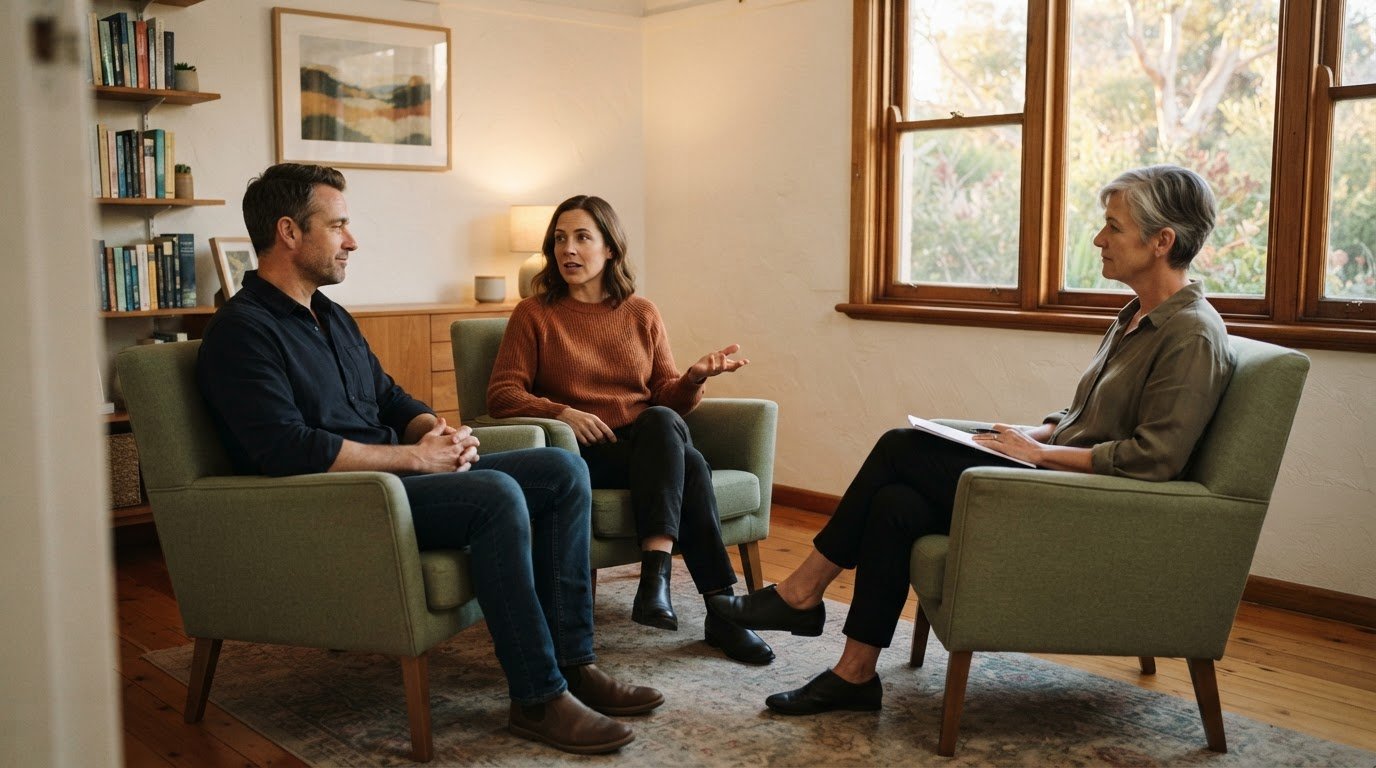
A first couples therapy session usually gives each partner space to describe their concerns, hopes and goals. Before attending, each person can note the relationship challenges they most want to discuss and reflect on their own behaviour, rather than preparing a case against their partner.
Therapy can’t make someone change simply because their partner brings them. It can help both people understand the relationship dynamic, including how one person’s response may affect the other. For example, one partner may push for a conversation while the other shuts down. Exploring this pattern encourages responsibility without deciding that either person is entirely at fault.
Research shows relationship counselling can help partners clarify their needs and practise new behaviours. Change is more likely to take hold when both people engage, make specific commitments and follow through between sessions. If you agree to share care tasks, for instance, decide who handles dinner on which nights, then revisit whether the arrangement feels fair.
Everyday practices can help keep commitments visible. A brief weekly check-in can make space to discuss what felt connecting, what was difficult and what each person needs next. Partners might also protect time together amid work or parenting demands. These practices do not erase structural stress, but they can help couples discuss its impact and make decisions as a team.
Work schedules, caregiving responsibilities, financial pressure and unequal household labour can strain a relationship. Counselling can help partners distinguish practical pressures from assumptions about each other’s intentions. Naming a constraint, such as conflicting shifts, makes it easier to consider realistic changes instead of repeating the same argument.
Relationship counselling can also support polyamorous partners. The counsellor’s role is to understand each person’s agreements, boundaries and relationship goals without treating one relationship structure as the default. Partners may want to discuss time, communication, jealousy or changes to an agreement. Clear, shared language helps everyone involved understand what is being decided.
Therapy can help partners navigate separation as well as repair. Some couples use sessions to clarify whether they want to continue; others work towards a more respectful transition. The focus can be on understanding needs and making considered decisions, rather than persuading one partner to stay.
If you’re ready to explore your relationship patterns together, you can book a couples counselling session as a starting point for that conversation.
What Increases the Success of Couples Counselling?
Couples counselling is more likely to help when both partners participate, stay curious and work towards change between sessions. Feeling understood and having goals that matter to both people can also shape the process.
Couples therapy fees in Australia vary by practitioner and session format. For budgeting, don’t assume a Medicare rebate applies to a couples session; individual mental health treatment is a separate consideration.
Australian Government marriage counselling research found that 79% of women and 91% of men considered divorce or separation less likely after counselling. The same report found that 78% of women and 83% of men said the issues they sought help for had changed for the better. These figures describe participants’ views, not a promise that every marriage will improve in the same way.
Across the research described in this topic, couples counselling has an improvement rate of 70% to 80%. It can help reduce relationship distress, including frequent arguments and dissatisfaction. Progress depends partly on whether partners can engage with the work, name what they want to change and practise new responses outside sessions. If depression affects one partner, individual support may help address that experience alongside the relationship impact.
Finding a suitable counsellor matters because both partners need room to speak without feeling the counsellor has taken sides. Research has not shown one counselling method to outperform every other approach. A steady, respectful working relationship can help partners discuss sensitive subjects, including intimacy, without turning sessions into a search for who is right. Allowing three or four sessions to assess the fit gives both people time to experience how the counsellor works.
Couples don’t need to wait until a relationship feels distressed to seek support. Premarital counselling can help partners discuss expectations about money, family, intimacy and future plans before differences become entrenched. Some types of counselling have been found to reduce divorce rates among newlyweds. Preventive sessions can also help partners notice early changes, such as less time together or recurring tension around household responsibilities.
Couple relationship education can offer another way to build skills before or during difficulties. A federal randomised trial found that couples reported relationship benefits at 12 months and 30 months. Those findings suggest that learning together can have lasting value, while ongoing practice still matters. For a couple deciding whether to begin, the useful question is what each person hopes will feel different, and what they’re willing to try toward that change.

Emotionally Focused Therapy outcomes
Emotionally Focused Therapy (EFT) helps couples notice the emotional patterns beneath recurring conflict. Rather than treating an argument as proof that one partner is the problem, EFT explores what each person may feel and need. For example, one partner might seek reassurance when they sense distance, while the other becomes quiet under stress. Seeing this cycle can help couples respond to underlying concerns instead of reacting only to the surface disagreement.
In EFT, the therapist helps partners slow familiar interactions and express vulnerable feelings more clearly. A couple might shift from “You don’t care” to “I feel alone when we stop talking after an argument.” This gives the other person a clearer way to understand the emotional meaning behind the words. EFT does not ask couples to avoid hard conversations; it helps them approach those conversations with greater openness and care.
EFT is a structured couples therapy approach focused on emotional connection and recurring interaction patterns. Its usefulness is better judged by the changes a couple seeks than by a single success figure. Partners might look for fewer escalating exchanges, more willingness to discuss difficult feelings or a stronger sense of being understood. These outcomes differ from one relationship to another.
Progress can mean more than staying together. One couple may want to restore closeness after a period of distance; another may need support to decide whether continuing feels right. Positive change might mean a calmer response to a familiar trigger, a more direct expression of need or greater clarity about each person’s hopes. Everyday signs include being able to revisit a disagreement without returning to blame.
EFT can offer a way to discuss painful experiences, including infidelity, when both partners are willing to engage. A therapist can make room for hurt, questions and boundaries without rushing towards forgiveness. Partners may need to understand the impact of what happened, discuss responsibility and identify what honesty would mean in practice. The conversation can move at a pace that lets each person take part meaningfully.
Because EFT involves approaching feelings partners may have been protecting themselves from, some sessions can feel emotionally demanding. Tell the therapist if a discussion feels overwhelming, then pause to clarify what would help each person stay present. The aim is not to produce the same outcome for every couple. EFT offers a framework for understanding the emotional cycle and exploring different ways to reach for connection.
Reasons couples therapy may not work
Couples therapy can stall when partners have different goals, limited motivation or little willingness to change their own behaviour. One person may hope to repair the relationship, while the other wants confirmation that separation is right. Naming that difference makes sessions more honest and useful.
Most couples attend weekly sessions for approximately 12 weeks, though the length varies with their goals. Progress isn’t measured only by staying together. A couple may work through recurring conflict, clarify what each person needs or reach a considered decision about the relationship. The focus of sessions matters as much as the number attended.
Attending sessions alone doesn’t create change. If partners discuss a new way to share responsibilities but return home to the same arrangement, the pattern is likely to continue. Practising agreed changes between sessions gives each person a chance to notice what feels different and where further support is needed. A missed session or difficult week can also interrupt momentum if neither partner brings it up.
Therapy may feel more painful before conversations become easier. Discussing betrayal, resentment or years of feeling unheard can bring strong emotions into the room. For example, a partner who learns new details about infidelity may need time to process them before discussing repair. A therapist can help pace difficult conversations, but both people need space to say when they feel overwhelmed.
Another challenge arises when one partner uses counselling to prove the other is wrong. If a therapist’s words are repeated at home as evidence against a partner, sessions can become another arena for blame instead of a place to understand the relationship. A constructive process focuses on each person’s experience, choices and responsibilities, rather than casting one person as the problem.
Couples counselling isn’t suitable for every situation. Where abuse or coercive control is present, joint sessions can create risks, especially if one partner feels unable to speak freely or safely. Safety comes first; individual support may be a more appropriate starting point than asking both partners to negotiate together.
Before committing to ongoing sessions, consider whether both people can speak honestly, hear difficult feedback and take responsibility for their actions. If the counsellor’s approach doesn’t feel like a workable fit, raise that concern directly. Useful work is not measured by a perfect session, but by changes partners can recognise in how they handle a familiar challenge.
The Project of You | Trauma, Couples & Relationship Therapy Australia: The Healing Feminine Workshops
The Project of You | Trauma, Couples & Relationship Therapy Australia offers different forms of support for people reflecting on relationship patterns and personal wellbeing. The Healing Feminine Workshops may suit those seeking a shared space for reflection, while Individual Counselling offers a one-to-one setting to explore personal experiences that affect relationships.
If stress or emotional overwhelm is making connection harder, Nervous System Regulation & Restoration offers another avenue of support. Self Love e-Books provide a self-guided resource for reflection between conversations or alongside other support. Each option serves a different need; the right starting point depends on what feels most useful to explore now.
If you’d like to talk about what kind of support may fit your circumstances, contact The Project Of You.
Take the next step at your own pace
You may still be asking, “Does couples therapy actually work?” A useful next step is to consider what you want support to help you understand, whether it’s a difficult decision, a repeated pattern or a wish to feel more connected. You don’t need a perfect explanation to begin. Starting with what feels hardest can help create a clearer path forward.
Starting a conversation about therapy can bring up uncertainty, especially if you and your partner feel differently about seeking help. You can begin by naming that uncertainty and asking what would make a first conversation feel respectful and worthwhile. If you’re considering support, choose a manageable next step rather than waiting for every concern to be resolved.
Whatever you decide, your willingness to pause, reflect and seek understanding is a meaningful place to begin. There’s room to find a way forward, one thoughtful step at a time.
Frequently Asked Questions
Does It Work for All Types of Couples?
Couples therapy can support people in different relationship structures, including same-sex and polyamorous relationships, when the process respects their needs and agreements. Whether couples therapy actually works depends partly on feeling safe enough to speak honestly and having goals that matter to those involved. For example, partners may want help discussing boundaries, navigating cultural expectations or deciding how to share time across relationships.
What Is the Success Rate of Couples Therapy?
There isn’t one success rate that captures every couple’s experience. Studies may define success as reduced distress, better communication or improved relationship satisfaction, and these outcomes aren’t interchangeable. One couple might value fewer painful arguments, while another prioritises renewed closeness. When considering results, look at what changed for the people in therapy and whether it matches their goals, rather than treating one statistic as a prediction.
What Percentage of Couples Survive Counselling?
There isn’t a single percentage that can reliably predict which couples will stay together after counselling. “Survival” measures only whether a relationship continues, not whether partners feel understood, safe or satisfied. Some couples use counselling to make a clearer decision about separating; others work towards staying together. A more useful measure is whether the process helps both people make an informed choice that reflects their needs and values.
What if one partner wants out?
If one partner wants to leave, therapy can help clarify what each person wants and which decisions need attention. It shouldn’t be used to pressure someone into staying. For instance, partners may explore whether doubts relate to a temporary rupture or a longer-standing mismatch. Even when their goals differ, a structured conversation can help them discuss next steps with greater care and clarify what each person is choosing.
When Love Feels Hard: Does Couples Therapy Actually Help?
Couples therapy may help when affection remains but daily life is dominated by tension, distance or competing demands. A couple adjusting to a caregiving role, for example, might use sessions to discuss how responsibilities affect closeness. Therapy can help uncover the concern beneath repeated disagreements and identify what each person wants to change. The aim is understanding and considered action, not pretending love alone resolves every challenge.
How effective is couples therapy for improving relationship satisfaction?
Therapy can support relationship satisfaction by helping partners identify what satisfaction means to each of them. One person may want more affection, while the other hopes for less tension around family decisions. Naming these differences clarifies the goal. Progress can be assessed through specific changes, such as feeling more included in decisions or being able to raise concerns without anticipating ridicule. Partners may experience progress differently.
What does research say about couples therapy success rates and long-term outcomes?
Research on couples therapy examines different approaches, couples and outcomes, so findings don’t provide a single forecast for an individual relationship. Longer-term outcomes also depend on what researchers measure, such as ongoing satisfaction or whether initial changes remain. For readers, the useful question is what a study calls improvement and whether that outcome matches their own hopes. A reported change in distress, for instance, doesn’t necessarily mean every relationship continues.
What factors make couples therapy more or less likely to work?
Therapy is more likely to feel useful when both partners can speak openly, consider their own contribution and agree on a meaningful focus. A difference in goals, such as one person seeking repair while the other wants to discuss separation, needs to be addressed directly. Emotional safety matters too: if someone fears punishment for speaking honestly, joint sessions may not be a workable setting. The counsellor’s ability to hold both perspectives is also important.


Comments