

Financial infidelity signs and how to recognize hidden money

What if the most important clue isn’t how much money was hidden, but what has become difficult to discuss? Financial infidelity signs can include undisclosed debt, secret accounts or purchases, and misleading a partner about income or spending. Discovering them can shake your sense of trust and safety, so it’s understandable to want clear answers without rushing to blame either person.
Financial secrecy can have different roots, including shame, fear of conflict, a need for independence or past experiences with money. Or, as psychotherapist and couples counsellor Azita Abdollahian explains, it can even be a form of abuse. Understanding the reason doesn’t erase the impact, but it can help you approach the conversation with care and curiosity. Hidden financial information may also be part of a wider pattern of control, so take your sense of safety seriously.
This article explains what financial infidelity means, why partners may hide money and how to raise concerns calmly and directly. It also explores what disclosure and recovery can involve, including rebuilding transparency and trust over time. You don’t have to decide the future of your relationship before seeking clarity.
Table of Contents
What is financial infidelity?
Financial infidelity means hiding or misrepresenting money matters in ways that break an understanding between partners. Some financial infidelity signs include concealing debt or purchases, keeping accounts secret and giving misleading explanations about spending.
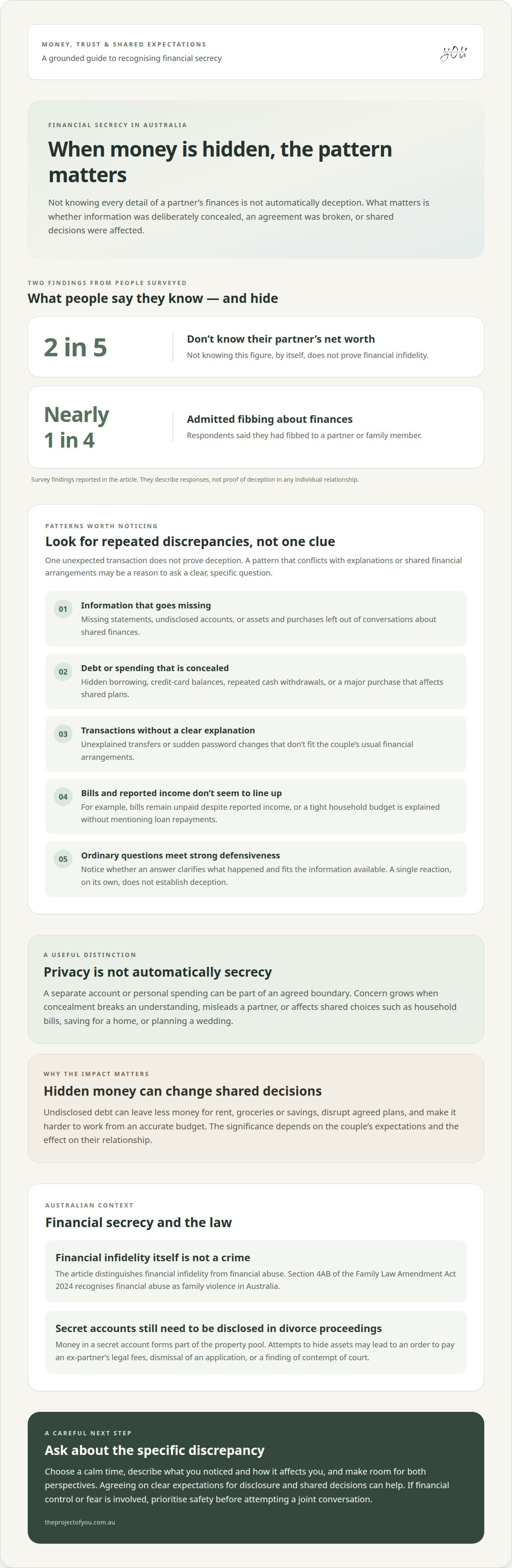
In Australia, two in five people surveyed don’t know their partner’s net worth, and nearly a quarter admitted fibbing about finances to a partner or family. Not knowing every detail isn’t automatically deception. What matters is the couple’s agreement and whether information was deliberately concealed.
Hidden purchases, assets and accounts
Hidden purchases, assets and accounts are financial resources or transactions deliberately kept from a partner. Concealment matters when it affects shared decisions, such as saving for a home, paying household bills or planning a wedding.
Examples include a secret credit card, cash savings in an undisclosed account, or investments left out of discussions about shared finances. Someone might also conceal a major purchase, such as expensive equipment, or an asset acquired during the relationship. A separate account isn’t automatically deceptive. The concern is whether it breaks an agreement or creates a misleading picture.
Undisclosed debt and spending
Undisclosed debt or spending means hiding borrowing, balances or purchases that affect a partner or shared plans. A personal loan, credit-card balance or repeated cash withdrawal might be concealed through incomplete statements or vague explanations.
For example, someone might blame a tight household budget on rising bills while omitting repayments on a personal loan. Hidden debt can leave less money for rent, groceries or savings, and delay decisions based on an accurate budget. The significance of the breach also depends on the couple’s expectations and its impact on their relationship.
Warning signs of hidden financial behaviour
Warning signs include repeated changes that don’t match a partner’s explanations or your shared financial arrangements. One unexpected transaction doesn’t prove deception, but a pattern may be a reason to ask a clear, specific question.
Other clues can include missing statements, unexplained transfers, sudden password changes, unpaid bills despite reported income, or strong defensiveness about ordinary questions. Ask about a specific discrepancy rather than making a broad accusation. Notice whether the answer clarifies what happened and fits the information available.
Privacy can be healthy when both partners understand the boundaries. Secrecy becomes more serious when one person controls the other’s access to money or restricts their choices.
Effects and risks of financial secrecy
Hidden debt can strain a relationship by undermining trust, disrupting shared plans and reducing money available for agreed expenses. Financial infidelity itself is not a crime in Australia. However, Section 4AB of the Family Law Amendment Act 2024 recognises financial abuse as family violence in Australia, according to the Federal Register of Legislation.
In Australian divorce proceedings, money in a secret account must be disclosed and forms part of the property pool. Attempts to hide assets may lead to an order to pay an ex-partner’s legal fees, dismissal of an application or a finding of contempt of court.
Consider financial counselling if debt or bills make household finances difficult to manage. Relationship counselling may help when secrecy recurs, conversations get stuck in blame, or trust feels hard to repair. If financial control or fear is involved, prioritise safety before attempting a joint conversation.
Definition and examples of financial infidelity
Financial infidelity is concealing or misrepresenting information about money in breach of an understanding between partners. Its meaning depends on the couple’s agreements, the extent of the secrecy and its effect on shared decisions.
Defining financial infidelity
For example, one partner might agree to disclose new borrowing but secretly apply for a personal loan. The breach isn’t simply having a separate bank account. It’s hiding information the other person reasonably expects to know under their shared agreement. This distinction helps couples discuss the behaviour without treating every difference in spending or privacy as betrayal.
A useful way to clarify the issue is to identify the agreement involved. Did you agree to discuss major purchases, disclose gambling losses or share information about debts before making joint plans? If one partner thought those matters were private while the other believed they were shared, the conflict may come from mismatched expectations. Naming that mismatch makes the conversation more specific than arguing that someone is simply “bad with money”.
For instance, someone may keep a modest personal purchase private because the couple has agreed that each partner can spend independently. The same purchase may feel deceptive if shared savings were meant for rent or a family holiday. Context matters. Couples can explore what they understood, what was concealed and whether the decision affected the other person’s choices.
The spectrum and examples
Financial infidelity can range from a concealed purchase to repeated, substantial deception involving borrowing, gambling or assets. Thinking in terms of a spectrum helps couples distinguish an isolated lapse from an ongoing pattern that affects their financial security.
At one end, someone might understate the cost of new clothes or fail to mention a small purchase after agreeing to discuss discretionary spending. Further along, a partner may hide credit-card balances, borrow from family without disclosure or use joint funds for gambling. At the more serious end, concealed loans or assets can affect housing decisions and plans for divorce.
Consider a couple saving for a deposit when one partner discovers the other has repeatedly used those savings for undisclosed gambling. The concern goes beyond the transactions. It may include a broken agreement, lost progress towards a shared goal and uncertainty about what remains available. Naming each impact separately can help keep the discussion from being reduced to a single label.
These examples show why couples need clear boundaries around privacy. One partner might keep an individual account for personal spending while both disclose debts that affect shared bills. Another couple may choose to discuss every purchase from joint savings. A disagreement about the boundary calls for clarification; deliberate concealment after a clear agreement can feel like betrayal.
If money conversations keep circling around blame or mismatched expectations, book a counselling conversation to explore what each partner understood and what needs to change.
Coming clean and discussing financial secrets
Talking about concealed finances can bring shame, fear and anger into the conversation. A calm structure can help partners share facts, understand the impact and agree on what transparency means going forward.
Prepare for an honest conversation
Choose a calm, distraction-free time instead of raising the issue during an argument or while paying bills. Start with one specific concern, such as an unexplained credit-card statement or a loan repayment you’ve discovered. Describe how the secrecy affected you, then invite your partner to explain. Listening doesn’t mean minimising the impact or agreeing with their account.
If you’re disclosing a secret, explain plainly what happened. Include the account or credit card involved, the amount owed, when the borrowing began and whether shared money was used. Avoid revealing one detail now and another later; partial disclosures can deepen uncertainty. If gambling or another addiction is involved, name it as a concern and discuss what support and safeguards may be needed.
Agree on financial boundaries before marriage
Before marriage, couples can discuss what they consider private and what affects shared decisions. For example, agree whether each person will disclose debts, assets, income changes and major purchases. A couple might use a joint account for rent and household bills while keeping individual accounts for personal spending, with clear limits they both accept.
These agreements work best when they’re specific. Decide which expenses need discussion, how you’ll manage shared bills and how often you’ll review plans together. One partner may value independence after growing up with strict money rules; the other may need openness because of earlier financial instability. Sharing these histories can help explain the feelings behind each preference.
Discuss documents and next steps
Credit-card statements, loan agreements and bank records can help clarify what happened. Ask to review relevant documents together, with each person explaining unfamiliar transactions. Don’t access accounts or documents without permission. If a statement is missing or a payment remains unexplained, note the question and agree on how to address it.
Then turn disclosure into practical agreements. Partners might decide how to share updates about new borrowing, protect essential household funds and discuss spending that affects joint goals. Check that the agreement feels workable for both people instead of imposing rules in the heat of the moment.
Pause the conversation if either person feels overwhelmed or unsafe. Agree when to return to it, or seek professional support if blame, fear or repeated secrecy prevents a clear discussion. The aim isn’t immediate forgiveness. It’s an accurate shared picture and a more honest way forward.
Reasons people hide money from partners
A partner may hide money out of shame, fear of conflict, a need for independence or concern about being judged. For example, someone who grew up hearing arguments about every purchase may conceal personal spending to avoid tension. Understanding a possible reason can guide a more curious conversation, but it doesn’t undo the effect of secrecy on shared plans.
Sometimes the reason involves behaviour that feels difficult to control, such as gambling or compulsive spending. Someone may hide transactions because they fear the consequences, feel overwhelmed by debt or struggle to explain what happened. These possibilities aren’t a diagnosis. They’re prompts for discussion: What was hidden? What need or fear was involved? What support or boundaries could help now?
Different experiences with money can shape expectations, too. One partner may see separate accounts as healthy independence, while the other expects all assets and debts to be discussed. If these assumptions go unspoken, a purchase or transfer can feel deceptive to one person and ordinary to the other. Naming the different expectations helps couples make clear agreements instead of relying on guesses.
To prevent financial infidelity with shared accounts and budgets, couples can agree on which income and expenses are shared, what remains personal and which decisions need discussion first. A joint account can cover household costs while each partner keeps an individual account for agreed personal spending. A shared budget can also make bills, savings goals and financial commitments visible to both people.
Regular money conversations can help keep transparency from becoming an interrogation after a hidden transaction comes to light. Couples might set a monthly household check-in to review upcoming bills, changes in income, shared goals and relevant documents. Keep the discussion focused: What has changed? What needs a decision? Does the current agreement still work? A routine review can make it easier to raise an unexplained expense before resentment builds.
A relaxed “money date” can help partners discuss finances without trying to resolve every disagreement at once. For example, each person can share one concern and one goal, then listen without interrupting. If money conversations bring up shame or fear, agree to pause and return at a set time. The pause should protect the discussion, not become a way to avoid it.
Transparency also needs to respect safety and choice. Shared access to accounts shouldn’t become a way to monitor or control a partner. If someone withholds money to restrict the other person’s basic choices, or a conversation feels unsafe, prioritise support and safety rather than relying on a joint budget alone.
Disclosure and recovery after financial infidelity
Disclosure is more than admitting that money was hidden. It means building an accurate picture of what happened and its effects. A partner may need to understand the debts, accounts, income changes and decisions involved before deciding what comes next. Clear information gives both people a starting point for practical choices, even when emotions remain unsettled.
A useful disclosure covers the amount owed, when borrowing began, which accounts were involved and whether shared funds were used. It should also include missed payments, assets, gambling or other spending that affects the household. For example, “I used our savings” leaves important questions unanswered. Naming the transactions and their impact can prevent further surprises and give the couple clear facts to work with.
For the person who concealed information, accountability means answering reasonable questions without minimising, blaming or revealing facts in fragments. If an earlier explanation was incomplete, correct it directly and explain what was left out. The hurt partner may need time to absorb the disclosure. You don’t have to decide immediately about forgiveness or the relationship.
Recovery can involve emotional repair and practical financial steps. Partners might list current debts and income, agree how to pay essential bills and set expectations for future disclosure. If gambling or another serious behaviour contributed to hiding money, the plan may also need to address that behaviour and its effect on trust. Consistent actions over time matter more than promises.
There is no fixed timeframe for rebuilding trust, and 1-2 years should not be treated as a typical recovery period or deadline. The time and course of rebuilding trust vary between couples. One partner might provide agreed financial updates, while the other works through hurt without being pressured to move on. Regular conversations can track whether agreements are being kept and identify new concerns before they deepen.
Couples don’t have to manage every conversation alone. A relationship counsellor can help keep disclosure specific, support each person’s emotional response and clarify what repair would require. Financial guidance can help with the practical picture of debts, repayments and shared commitments. Counselling isn’t a substitute for urgent financial or safety support when those needs arise.
Rebuilding trust doesn’t mean forgetting what happened. It means facing the full disclosure, understanding the impact and seeing whether both partners can sustain honest change. If conversations keep returning to denial, new discoveries or escalating distress, support can create a steadier space to decide what to do next.
The Project of You | Trauma, Couples & Relationship Therapy Australia: Infidelity Recovery
The Project of You | Trauma, Couples & Relationship Therapy Australia offers Infidelity Recovery for people and couples facing secrecy, hurt or uncertainty about what comes next. Support can help you explore the impact of financial betrayal, understand each person’s experience and consider what rebuilding trust would involve, without rushing a decision about the relationship.
If tension or overwhelm makes money conversations difficult, Nervous System Regulation & Restoration may help create a steadier space for reflection. The right next step might be individual support or working together as a couple, depending on your circumstances and sense of safety.
If you’d like support to explore your next step, contact The Project of You | Trauma, Couples & Relationship Therapy Australia.
Choose a next step that feels steady
The financial infidelity signs you’ve noticed can help you understand what matters to you now: honesty, emotional safety, shared responsibility or time to make decisions. You don’t need to resolve every question at once. A considered next step might be a private conversation, individual support or space to reflect before deciding whether to work on the relationship together.
Repair depends on what both people are willing to understand and change. Notice whether actions begin to match stated intentions while staying connected to your own boundaries and wellbeing. If the experience has stirred shame, grief or uncertainty, self-compassion can help you move at a manageable pace.
The Project of You | Trauma, Couples & Relationship Therapy Australia offers The Healing Feminine Workshops and Self Love e-Books as additional spaces for reflection and personal growth.
You can move towards clarity without having all the answers today.
Frequently Asked Questions
Is hiding a bank account from your spouse illegal?
Hiding a bank account is not, by itself, a crime in Australia. The situation changes in family law proceedings: money held in a secret account must be disclosed and forms part of the property pool. Section 4AB of the Family Law Amendment Act 2024 recognises financial abuse as family violence, according to the Federal Register of Legislation. A hidden account may therefore raise serious concerns beyond relationship trust.
What should I do if I discover my partner's hidden debt?
Start by separating what you know from what you still need to understand. Note the lender, balance, repayments and whether the borrowing affected shared bills or savings. Keep your own financial records accessible, and avoid agreeing to take on a debt before you understand the arrangements. If an upcoming payment could affect essentials such as rent or utilities, prioritise a clear household budget and seek appropriate financial guidance.
How can you tell if your partner is hiding debt or secret spending?
Look for inconsistencies in the financial information you already share. For example, household income may appear unchanged while agreed savings contributions keep falling or a joint account shows unexplained withdrawals. A lender’s letter or a repayment on a shared statement can prompt questions, but one discrepancy doesn’t prove concealment. Ask about the specific transaction and notice whether the explanation fits the information available.
What financial behaviours count as financial infidelity?
Financial behaviour may count as infidelity when it breaks an agreement or misleads a partner about decisions affecting shared finances. Examples include taking out a loan after agreeing to disclose borrowing, understating income used for household planning, or spending joint savings without the agreed discussion. An individual account or private purchase isn’t automatically deceptive if both partners understand and accept that boundary.
What causes financial infidelity in relationships?
There isn’t one cause. Someone may conceal a purchase because they expect criticism, hide debt because they feel ashamed, or keep savings separate to preserve independence. Gambling or another difficult-to-manage behaviour can also contribute to secrecy. These possibilities may explain what was happening, but they don’t determine its impact. A useful question is what the person feared would happen if they were honest.
How should you talk to your partner about suspected financial infidelity?
Raise one clear concern at a time, using a specific example rather than a broad accusation. You might say, “I noticed a repayment on our statement that we haven’t discussed. Can you explain what it’s for?” Allow time for an answer, and pause if either person becomes overwhelmed. If you’re concerned about control or your safety, avoid confronting your partner alone and focus first on support and safety.
What steps can couples take to rebuild trust after financial infidelity?
Trust can be rebuilt through consistent openness and actions that match new agreements. Couples might create a shared overview of debts, income and essential commitments, then decide how to share updates. Set a time to review the agreement and discuss what’s working instead of relying on reassurance alone. If conversations repeatedly stall or cause intense distress, relationship counselling can help partners work through the impact together.



Comments